Why the Oriental Plane Tree Has Sheltered Generations
The Oriental plane tree (Platanus orientalis) is one of the great shade trees of southeastern Europe and southwestern Asia. A mature specimen can spread its branches like a living roof over a spring, village square or garden. According to Kew’s botanical profile of Platanus orientalis, it is a large deciduous tree with a spreading crown, deeply lobed leaves, peeling bark and hanging clusters of bristly fruit. For centuries, people have planted it wherever cool shade, water and public life meet.
That relationship between tree and community has given the species an unusually rich history. Ancient writers praised its shelter, travelers carried it beyond its native range, and generations gathered below its canopy. Even today, famous old specimens remain living landmarks in botanical gardens and historic settlements.
Oriental Plane Tree Facts at a Glance
| Category | Verified information |
|---|---|
| Scientific name | Platanus orientalis L. |
| Family | Platanaceae |
| Common English name | Oriental plane tree or Oriental plane |
| Native range | Eastern Mediterranean, southeastern Europe and southwestern Asia eastward to northern Iran |
| Typical height | Usually up to about 30 metres; some specimens may grow taller in favourable conditions |
| Habitat | Riverbanks, stream valleys, springs and other places where moisture remains accessible |
| Longevity | Commonly several centuries; more than 500 years is well documented as a species capability, while exceptional veterans are estimated to approach or exceed 2,000 years |
| Leaves | Alternate, deciduous and palmately divided into three, five or seven toothed lobes |
| Flowers | Small, unisexual male and female flowers in separate spherical clusters on the same tree |
| Fruit | Numerous achenes packed into round, bristly heads, commonly grouped three to five on a hanging stalk |
| Main uses | Shade, ornamental planting, furniture, veneer, cabinetmaking, inlay, pulp and paper |
A Canopy Built for Shade
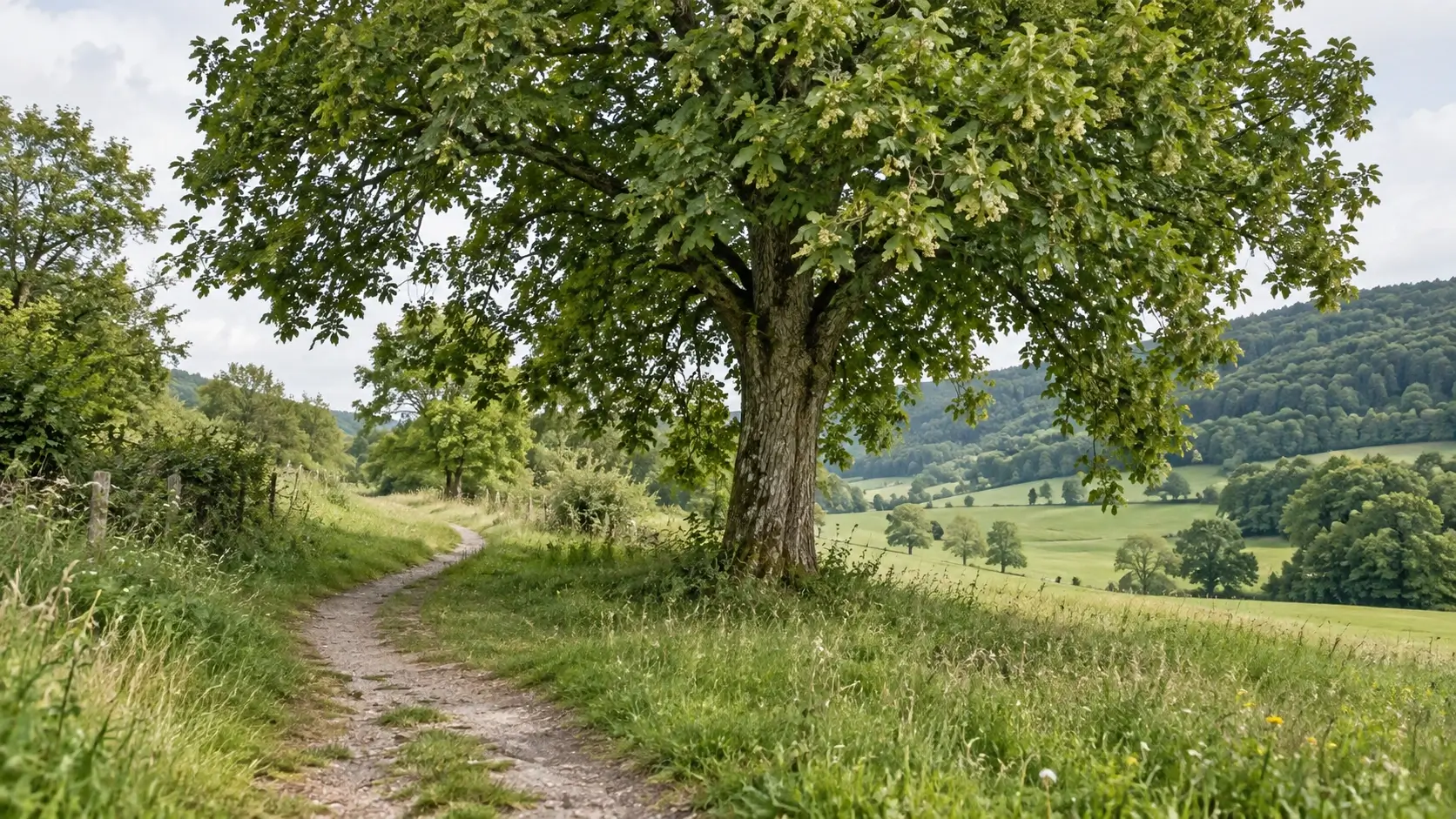
The first impression made by a mature Oriental plane tree is not simply height but reach. In an open position, powerful limbs extend outward and may descend as they become heavier. The broad, horizontally held leaves intercept both overhead and lower-angled light, creating dependable summer shade.
The species therefore works like natural architecture. A single old tree can create a cool outdoor room for resting, eating or meeting beside a fountain. In hot Mediterranean landscapes, this was practical rather than merely decorative.
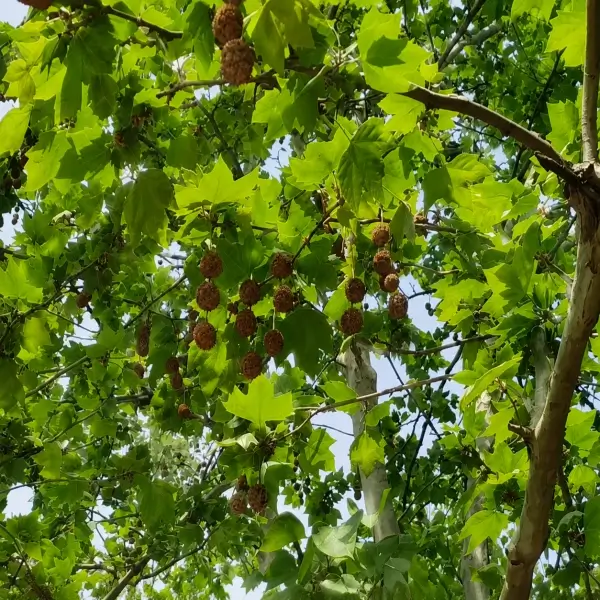
How to Recognize Platanus orientalis
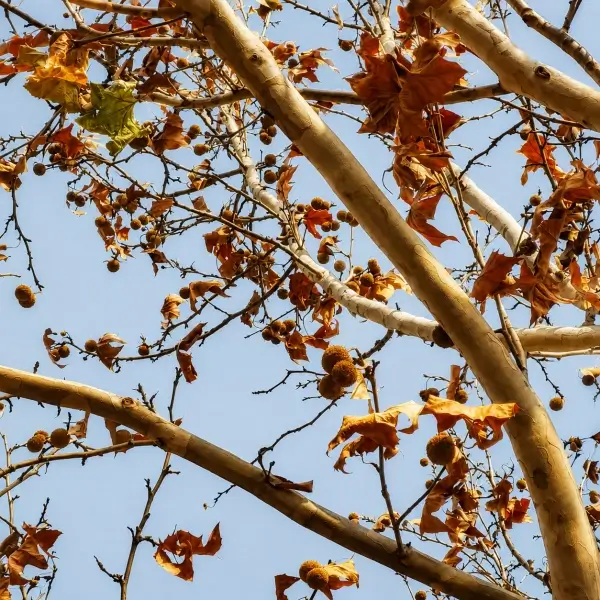
The trunk is often the clearest clue. Sections of ageing bark fall away, exposing cream, grey-green or tan patches beneath darker reddish-brown layers. Very old trunks may become rugged, swollen, hollow or divided.
The alternate leaves resemble a deeply cut hand. Kew records three, five or seven coarsely toothed lobes, although five is especially familiar. Autumn colour ranges from yellow and amber to red-brown.
Separate male and female flowers grow on the same tree in small hanging spheres. Female clusters become bristly heads made of many achenes. Fruiting branchlets usually carry three to five heads about 2–2.5 centimetres across. The Chinese name often rendered as “three-ball plane” reflects this feature, but the number is not fixed at three. Clusters may remain after leaf fall, aiding winter identification.
A Waterside Native with Urban Resilience
The natural range of the Oriental plane tree extends from the eastern Mediterranean and southeastern Europe into southwestern Asia and northern Iran. Its original boundary is difficult to reconstruct because people have moved it since antiquity. A 2024 study of the evolutionary origin of Platanus orientalis uses fossil leaves to examine its much deeper biogeographic history.
In the wild, it grows beside rivers, temporary watercourses and springs, including mountain sites up to about 1,500 metres in parts of its range. Established trees tolerate seasonal dryness when their roots can still reach moisture.
This toughness also helps in cities. The EUFORGEN Oriental plane profile notes tolerance of pollution, compacted soils, root disturbance and strong winds, although the tree still prefers well-drained ground and moisture. For broader context, see How Trees Grow.
How Long Can the Oriental Plane Tree Live
An Oriental plane tree can live for many centuries. EUFORGEN reports survival beyond 500 years, while several monumental individuals are estimated at 1,000–2,000 years or more. These are not exact birthdays: the oldest trees often have hollow trunks, missing central wood, fused stems or repeated regrowth, making ring counting impossible.
The celebrated Tnjri has an enormous fragmented trunk and is estimated at more than 2,000 years. Trees and Shrubs Online’s species account explains both the plausibility and uncertainty of such ages. Thus, “about 500–600 years, with exceptional trees estimated near 2,000” is a responsible summary, not a fixed limit. See also Do Trees Have a Lifespan Limit.
Size data require similar care. Some old planes exceed ten metres in trunk girth, but girth is circumference, not diameter. A ten-metre diameter is not a normal species characteristic.
Why Ancient Communities Planted It
In Greece, Anatolia, Persia and neighbouring regions, the tree’s shade made it a centre of social life. It was planted near springs and water channels, where villagers collecting water could also rest, eat or meet beneath its canopy.
The Oriental plane tree also became important in gardens, roads and ceremonial landscapes. Its principal gift was not edible fruit but a cooler place to live, helping explain why this non-fruit tree was carried westward in antiquity.
Pliny and the Plane Tree That Drank Wine
Pliny the Elder recorded the plane tree’s fame in Book XII of Natural History. In EXTERNAL LINK: Project Gutenberg’s English edition, he said it had been imported for shade and described wine being poured around the roots in the belief that it strengthened them. He joked that humans had taught trees to drink.
This is cultural history, not modern horticultural advice. Pliny also described a vast plane in Lycia whose hollow interior resembled a house and where a Roman official and eighteen companions supposedly dined. Literal or embellished, the account shows how an ancient Oriental plane tree could be perceived as a landscape in its own right.
From the Eastern Mediterranean to Kew and Paris
Pliny described planes moving across the Ionian Sea into Sicily and onward through the Roman world. Later introductions carried the species into western and northern Europe wherever climate, soil and water allowed.
Two garden trees make that history tangible. Kew’s historic Oriental plane among the Old Lions came from Whitton in 1762 and stands near the Orangery. France’s National Museum of Natural History records an Oriental plane planted under Buffon in 1785 at Paris’s Jardin des Plantes. Both show how gardens preserve living history.
Timber and Practical Uses
The Oriental plane tree also supplies fine, even-textured wood. Quarter-sawn boards may show a lace-like figure, giving decorative veneer the name lacewood. The timber finishes smoothly and is used for furniture, cabinetry, inlay, barrels, crates and smaller objects.
The University of Florida’s Oriental planetree profile describes it as tough, dense and hard enough for furniture and butcher’s blocks. EUFORGEN lists cabinetmaking, inlay, pulp and paper but calls the timber not very durable. It is therefore valuable indoors, while untreated outdoor durability should not be overstated.
Conservation Beyond Famous Old Trees
Famous veterans can create a false impression of security. The 2017 global IUCN assessment lists the species as Data Deficient, meaning evidence was insufficient for a confident global risk category, while regional populations face clearer pressures.
EUFORGEN identifies habitat destruction, agricultural expansion, fragmentation and hybridization as concerns. Altered watercourses can damage streamside habitat, while small isolated populations may suffer low gene flow. Protecting veterans matters, but so does preserving water systems and natural regeneration.
This wider responsibility connects with Luckytata’s Planting Trees for Tomorrow initiative, which turns admiration for remarkable trees into practical care for future generations.
Why the Oriental Plane Tree Still Matters
The Oriental plane tree unites biology, utility and memory in a single form. Its roots seek enduring moisture, its mottled trunk records continual renewal, and its vast crown creates a shared refuge from heat. Woodworkers have valued its patterned timber, gardeners have planted it for beauty, and communities have gathered beneath it for centuries.
Its greatest lesson may be that a tree becomes culturally important through the life that happens around it. From eastern Mediterranean waterways to ancient village squares, Kew Gardens and the Jardin des Plantes, the Oriental plane tree has endured because people repeatedly recognized the same gift: one living canopy can shelter generations.