The Wild Cherry Tree Supports Wildlife Through Every Season
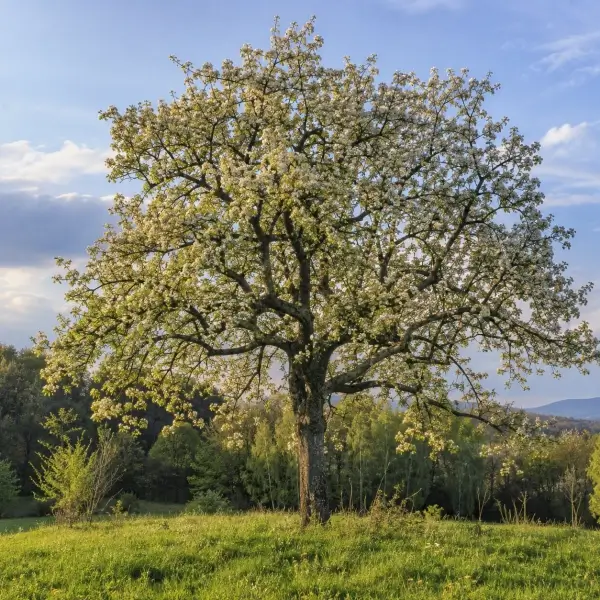
The wild cherry tree, known scientifically as Prunus avium, is one of Europe’s most recognizable spring-flowering forest trees. Clouds of white blossom appear before the woodland canopy has completely filled out, followed later by glossy red to almost black cherries that attract birds and mammals. Yet this species is far more than a beautiful seasonal sight. It is a pioneer of woodland edges, an early source of nectar and pollen, a valuable timber tree and the wild relative of cultivated sweet cherries.
Its relationships with insects, birds and mammals make it an especially vivid example of how one tree can support an entire network of forest life.
What Is a Wild Cherry Tree?
Prunus avium belongs to the rose family, Rosaceae. Its common names include wild cherry, sweet cherry and gean, while domesticated forms cultivated primarily for fruit are usually referred to as sweet cherries.
The wild cherry tree is generally considered a medium-sized deciduous tree. European forestry guidance describes mature individuals as commonly reaching around 20 to 25 metres, although exceptional specimens can grow considerably taller. Its normal lifespan is often around 70 to 100 years under suitable conditions.
Young trees usually develop a relatively straight trunk and a narrow, structured crown. With age, the crown becomes broader and more spreading.
The bark provides one of the easiest identification clues. It is typically reddish-brown and glossy when relatively young, marked by distinctive horizontal lenticels. Thin sections of bark may peel away in horizontal strips, giving older trunks a recognizable layered appearance.
The leaves are alternate and broadly oval, ending in pointed tips with serrated margins. Near the base of the leaf blade or upper part of the petiole are small reddish glands.
Those tiny glands are more important than they initially appear.
Where the Wild Cherry Tree Grows
The natural range of Prunus avium stretches through much of Europe, eastward through western Asia toward Afghanistan, and into parts of North Africa. Kew’s global botanical database records the species as native throughout a broad temperate region rather than as a tree restricted only to Europe.
Within forests, the wild cherry tree usually occurs as scattered individuals rather than forming extensive pure stands.
It particularly favors woodland margins, forest clearings, hedgerows and glades where sunlight is readily available. EUFORGEN describes wild cherry as a light-demanding pioneer species capable of quickly occupying clearings before eventually facing competition from more shade-tolerant hardwoods.
Deep, fertile and well-drained soils generally provide the best conditions. Adequate moisture is helpful, but prolonged waterlogging is not. Although the species can withstand cold winters, spring blossom may still be vulnerable to late frost.
Its preference for light also explains why wild cherries are so noticeable along forest edges rather than deep beneath permanently closed woodland canopies.
Spring Blossom and the First Rush of Pollinators
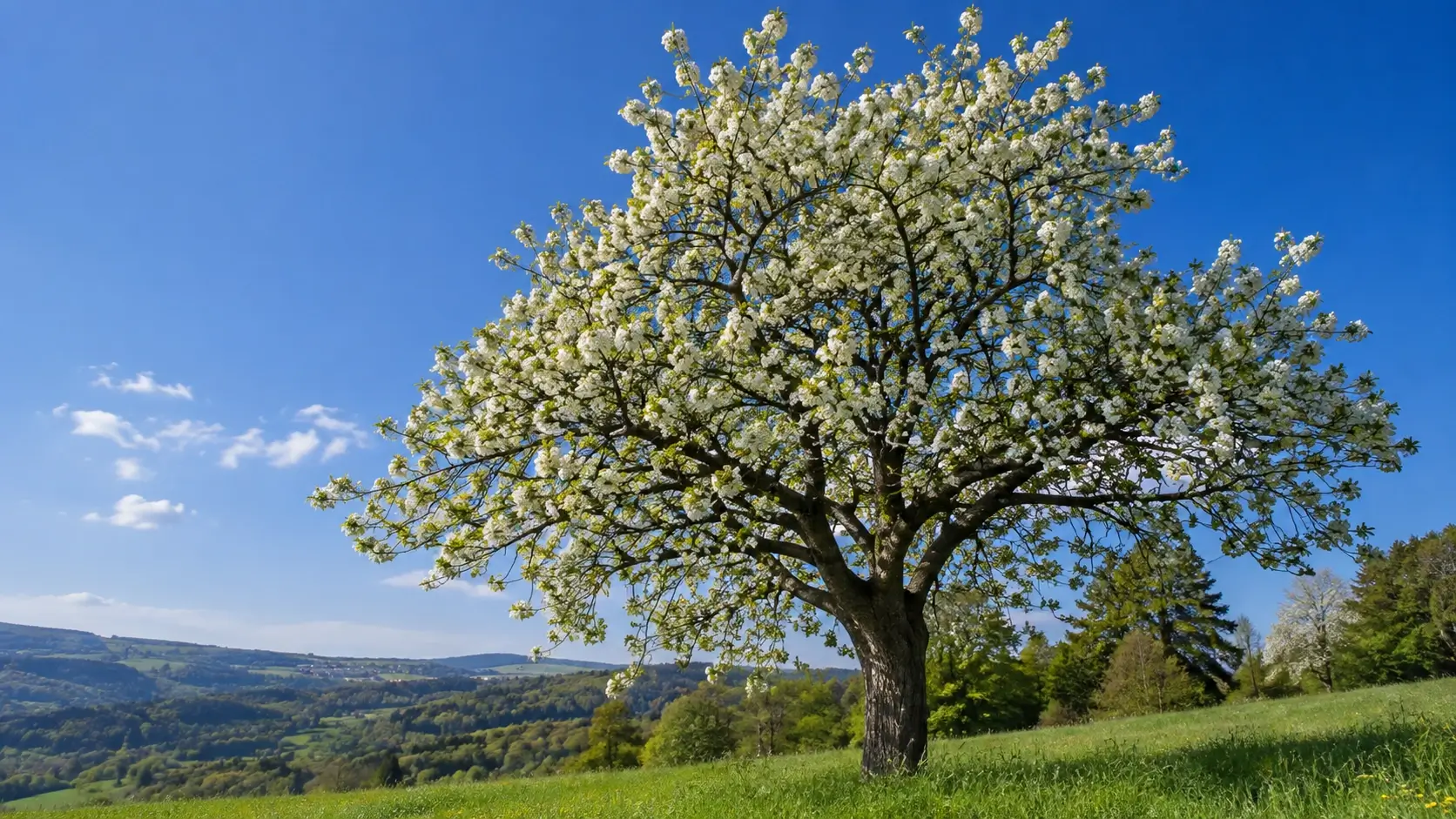
One of the most memorable stages in the life of a wild cherry tree arrives in early spring.
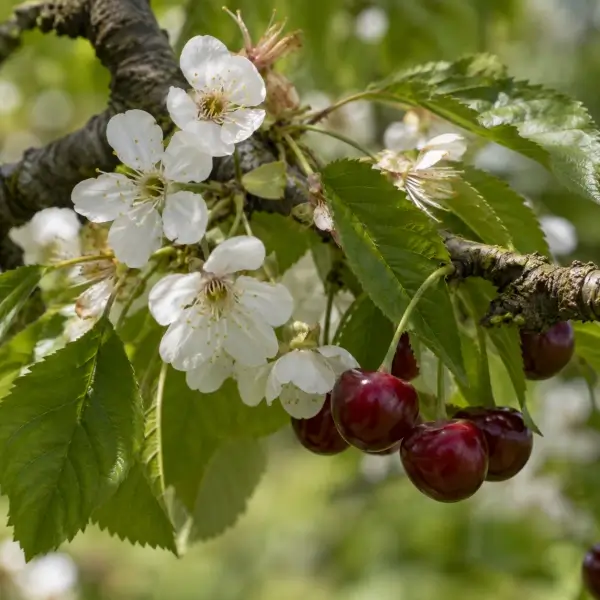
Before many surrounding trees have fully developed their leaves, branches can become covered in clusters of white flowers. Seen across a woodland, a flowering cherry can resemble a small cloud of white suspended among darker trees.
In Britain and much of temperate Europe, flowering frequently occurs around April, although colder regions may experience later blossom.
The flowers contain both male and female reproductive structures, but Prunus avium is generally self-incompatible. Successful reproduction therefore depends on pollen moving between compatible individuals. Insects perform much of this work.
Bees and other pollinating insects visit cherry flowers for nectar and pollen. Woodland Trust identifies wild cherry blossom as an important early source of both resources for insects.
The result is an ecological exchange.
Pollinators receive an early-season food source, while their movements among flowers help the tree produce the fruits that will later feed an entirely different group of animals.
Why Ants Visit the Wild Cherry Tree
The tiny reddish glands near the base of cherry leaves are known as extrafloral nectaries.
Unlike the nectar inside flowers, their purpose is not directly connected with pollination. Instead, they produce sugary secretions outside the flower that can attract ants and other arthropods.
That creates one of the most fascinating relationships surrounding the wild cherry tree.
Research published in Functional Ecology investigated how Prunus avium responded to simulated herbivore damage. Seedlings subjected to artificial leaf damage subsequently produced significantly more extrafloral nectaries than undamaged control plants. Researchers have also documented ants visiting these nectar-producing structures.
The likely ecological explanation involves defensive mutualism.
The tree offers a small food reward. Ants are encouraged to patrol the leaves and branches. While searching for nectar, they may encounter caterpillars or other herbivorous insects and attack, disturb or remove them.
Oxford University’s botanical collection similarly notes the presence of two extrafloral nectaries near the leaf base and their association with ant activity.
This does not mean that ants provide perfect protection or that every interaction produces the same result. Natural ecosystems rarely work so simply.
But it reveals something remarkable.
Two tiny reddish glands that a casual observer might ignore can form part of a much larger interaction between a tree, nectar, insects and herbivores.
Cherry Season Belongs to the Birds
Following spring pollination comes another important stage — fruit.
Wild cherries develop as small fleshy drupes, usually changing from green to red and eventually becoming deep red or almost black as they ripen.
Wild fruit does not necessarily have the uniform sweetness associated with supermarket cherries. Some trees produce relatively sweet fruit, while others can taste noticeably more bitter.
For wildlife, however, the summer crop can be extremely valuable.
Birds including thrushes, starlings, pigeons and jays have been recorded feeding on wild cherry fruit. Small mammals also consume cherries either from the branches or after they fall to the ground.
This consumption benefits the wild cherry tree as well.
Animals move seeds away from the parent plant. Birds may swallow the fleshy fruit and later deposit the hard stone elsewhere, potentially allowing a new cherry tree to establish in a clearing or woodland margin.
The scientific name even reflects this relationship. The Latin-derived name avium is associated with birds, a fitting reference for a species whose fruits are so closely connected with avian life.
Bright fruit is therefore more than decoration.
It is effectively part of the tree’s transportation system.
How the Wild Cherry Tree Supports Forest Wildlife
Birds are only one part of the ecological network.
Cherry blossom provides nectar and pollen for insects. Its foliage serves as a food source for the larvae of several moth species. Fruits support birds and mammals. Branches and foliage also contribute shelter and structural diversity within mixed woodland.
Woodland Trust specifically records blackbirds and song thrushes among birds eating the cherries, while mammals associated with the fruit include dormice, mice and badgers.
The wild cherry tree therefore demonstrates why ecological importance should not always be measured simply by how many trees of a species are present.
Wild cherry frequently occurs only as scattered individuals.
Yet one scattered tree can offer thousands of flowers during spring and a concentrated supply of fruit later in the year.
Its ecological importance changes with the seasons.
Spring belongs to flowers and pollinators.
Summer belongs to cherries and fruit-eating animals.
Throughout the growing season, insects interact with leaves, nectar glands, bark and branches.
From Wild Cherry to the Sweet Cherries We Eat
Wild cherry is also deeply connected with human agriculture.
The domesticated sweet cherry belongs to the same species, Prunus avium. Cultivated cherries have been selected over generations for characteristics such as fruit size, sweetness, productivity and consistency.
Wild populations remain important because they preserve genetic diversity that may prove valuable for breeding, conservation and forestry.
Cherry trees have also historically been used as rootstock for cultivated varieties. Oxford University’s botanical collection notes the important relationship between Prunus avium and cultivated European and western Asian cherries.
Humans have found many uses for the fruit.
Cherries are eaten fresh and transformed into preserves, desserts and beverages. Sweet cherries are also used in fermented and distilled products. One of the best-known examples is kirsch or Kirschwasser, a clear cherry spirit traditionally associated with parts of Germany, France and Switzerland.
What begins as a woodland fruit has therefore become part of both agriculture and regional food culture.
Why Wild Cherry Wood Has Long Been Valued
Fruit is only one reason people value Prunus avium.
The wild cherry tree also produces highly desirable hardwood.
EUFORGEN describes cherry timber as straight and fine-grained, with pinkish-brown heartwood and lighter sapwood. It is sought after for furniture, cabinetmaking, panelling, decorative joinery and turned objects.
Other botanical references also record its use in veneers and musical instruments.
The attraction is easy to understand.
Cherry wood develops warm tones that may range from pinkish brown to deeper reddish or orange-brown shades. It can produce a smooth surface and polished appearance without hiding its natural grain.
That makes the material especially suitable for objects in which the wood itself is meant to remain visible.
Fine furniture, cabinetry and instruments benefit from precisely this combination of strength, workability and appearance.
Wild cherry grows relatively quickly during its early years.
Its ecological strategy differs markedly from trees whose primary advantage comes from surviving for many centuries.
Rather than waiting beneath deep shade, cherry takes advantage of light.
A storm, fallen tree, cleared field edge or disturbed woodland can create an opening. Seeds or root suckers allow cherry to establish quickly. Once sunlight reaches the young tree, rapid growth helps it occupy the new space.
EUFORGEN therefore classifies it as an essentially pioneer species.
A typical lifespan of around 70 to 100 years may appear modest beside ancient oaks, yews or giant conifers, but it is more than enough time for generations of birds, insects and mammals to depend upon the same tree.
The wild cherry tree does not need to become ancient to become important.
Its ecological strength comes partly from arriving quickly, flowering generously and connecting different species through food.
Why the Wild Cherry Tree Matters
The wild cherry tree brings together many of the relationships that make a forest function.
Its spring flowers provide nectar and pollen.
Its unusual leaf glands interact with ants and other insects.
Its summer cherries feed birds and mammals, which in turn help move seeds into new places.
Its timber has supported generations of craftspeople.
And its domesticated relatives have become some of the world’s most familiar fruit trees.
What first appears to be simply an attractive flowering tree is therefore a meeting point between plants, insects, birds, mammals and people.
Prunus avium reminds us that a forest is not merely a collection of trunks standing next to one another. It is a continuous system of exchanges.
Through blossom, nectar, fruit, seed and wood, the wild cherry tree has built relationships that extend far beyond its own branches.