The Science Behind Tree Longevity
Do trees die of old age? The short answer is no—at least not in the biological sense. As long as environmental conditions remain optimal, a tree will not die of natural aging the way humans do. There is no absolute tree lifespan limit, and this fundamental biological difference is what truly sets them apart from humans.
We humans are typical centralized organisms: if a vital organ like the heart or brain fails, our entire bodily system collapses. Furthermore, human somatic cells are bound by the Hayflick limit; after dividing about 50 times, they stop, making our aging completely irreversible. Trees, however, operate on an entirely different survival logic, practically serving as nature’s loophole for biological immortality in trees.
The Secrets to Biological Immortality in Trees
Why do trees live so long? The primary secret to their extraordinary longevity lies in their incredible meristematic tissues. Both the tips of their branches and the ends of their roots contain stem cells that retain the ability to divide indefinitely. This acts as a body-wide regeneration factory, continuously growing new roots, branches, and leaves. When old tissues wither, they are directly replaced, allowing the tree to perfectly bypass the cellular lifespan shackles that bind animals.
Furthermore, trees utilize a highly efficient modular, distributed architecture. The roots, trunk, branches, and leaves function as independent units. If one part is damaged or dies, it does not threaten the survival of the main organism. Much like an unsinkable ship where broken parts are continuously swapped out, the entity as a whole remains resilient.
Trees are also masters of energy conservation. The thick, sturdy core of a mature trunk is actually dead heartwood, serving only to bear weight. Only a incredibly thin layer just inside the bark (the cambium) consists of living tissue. This localized “power down” mode drastically reduces energy consumption, enabling an ultra-long lifespan. Additionally, trees possess a powerful injury isolation technique—compartmentalization. They actively seal off decaying or infected areas to prevent the spread of disease, effectively functioning as a built-in firewall and immune system.
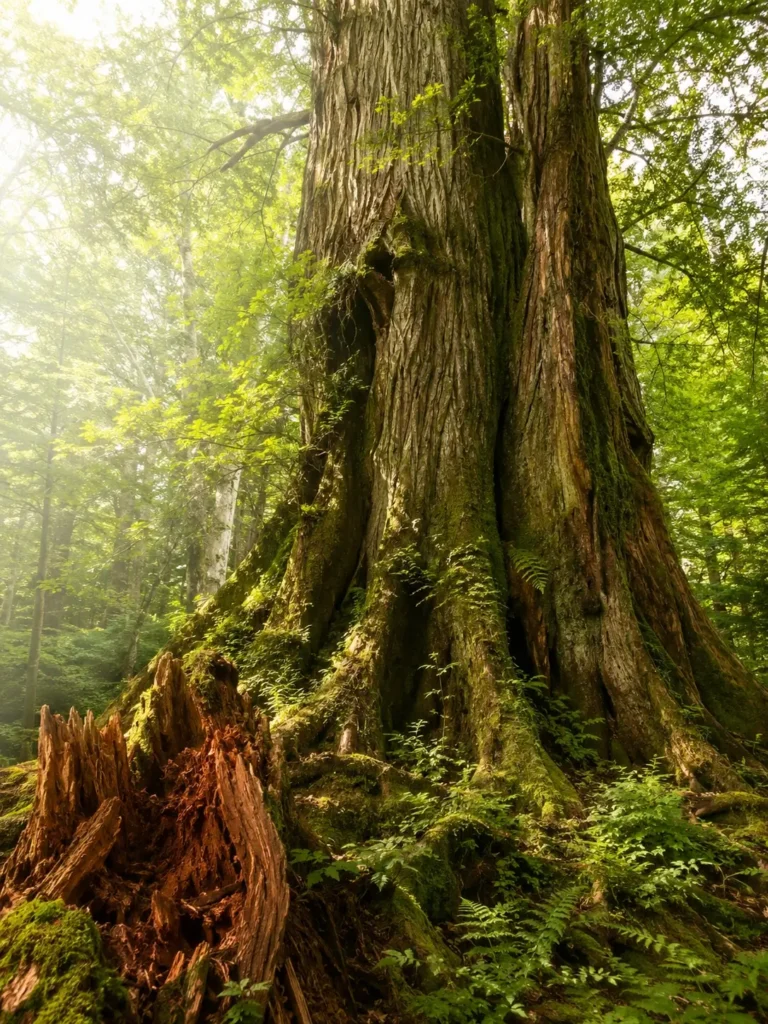
The Oldest Trees in the World: Real-Life Examples
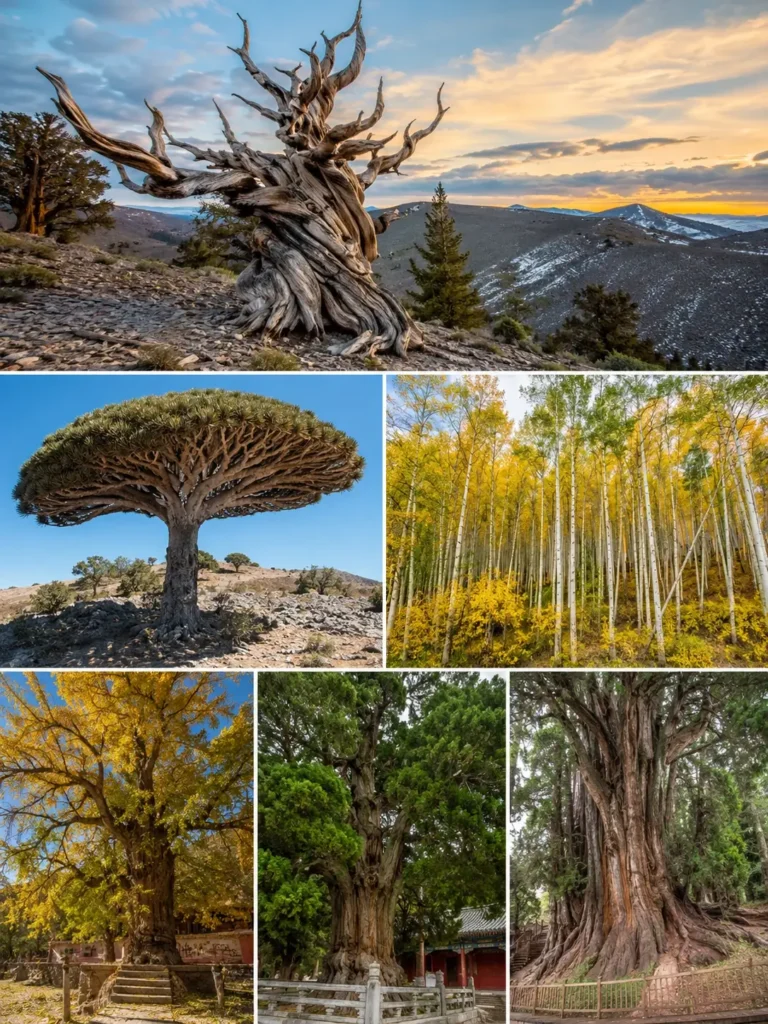
In reality, the longevity records of trees are astonishing. According to authoritative scientific dating, the oldest trees in the world include a Great Basin bristlecone pine in the White Mountains of California. One unnamed specimen is 5,074 years old—older than the Egyptian pyramids! The famous Methuselah tree, another bristlecone pine, is 4,856 years old, and its exact location remains a closely guarded secret to protect it from vandalism.
Historically, a dragon blood tree in the Canary Islands was estimated to be between 8,000 and 10,000 years old before it was tragically destroyed by a storm. The Pando aspen clone in the United States takes this to an extreme: while a single trunk only lives up to 130 years, its root system continually sprouts new shoots, bringing the clonal colony’s estimated lifespan to a staggering 80,000 years.
China is also home to numerous ancient trees, such as the 1,600-year-old Ginkgo in Tianmu Mountain, the 2,400-year-old Cypress in Qufu, and the 3,000-year-old Red Cypress in Alishan. These ancient survivors have witnessed the rise and fall of countless dynasties while remaining lush and vibrant. Data shows that the lifespan of seed plants varies wildly from 28 years to over 4,900 years. Generally, gymnosperms (like conifers and ginkgos) live much longer than angiosperms, representing the absolute ceiling of the plant kingdom’s longevity.
Can Trees Live Forever? The Realistic Limitations
Seeing all this, you might wonder: if trees are so resilient, can trees live forever? The realistic answer is no. While theoretical biology says there is no absolute tree lifespan limit, practical reality has boundaries. Even in the absence of natural disasters or human interference, trees cannot escape three major biological constraints:
- Genetic and Cellular Degradation: Although meristematic tissues have phenomenal division capabilities, long-term replication inevitably accumulates DNA errors. Disease-resistance genes gradually lose their activity, repair capabilities weaken, and microscopic damage compounds over time, eventually draining the tree’s overall vitality.
- Energy Supply and Demand Imbalance: As a tree grows taller and more massive, the energy required to simply maintain its huge structural framework increases. Less and less energy is available for generating new growth, eventually pushing the tree into an unsustainable energy deficit.
- Vascular System Failure: The xylem (water-conducting vessels) can become clogged or deteriorate over decades and centuries. If the creation of new vessels cannot keep up with the rate of degradation, the top of the tree will ultimately dry out and die.
This doesn’t even account for fatal external threats like lightning strikes, wildfires, severe droughts, pests, and human deforestation. Any of these can abruptly end a tree’s life. Interestingly, a Japanese study analyzing 1.07 million trees found that the average lifespan of major tree species is only 81 years, with a maximum average of 378 years. This mirrors the human demographic pattern where centenarians are rare, except the overall ceiling is stretched much higher for trees.
Nature's Ultimate Survival Wisdom
Ultimately, do trees die of old age? Biologically, no. However, due to the combined limitations of genetics, energy, physical structure, and the environment, they cannot achieve true immortality. Their extraordinary longevity is the result of extreme evolutionary survival wisdom.
Slow growth, robust repair mechanisms, and a distributed physical structure—every aspect perfectly aligns with the code for long life. Those ancient trees standing for millennia are more than just plants; they are the rings of the earth and the physical markers of time. They quietly prove to us that the length of a life has more than one answer.