Why the African Baobab Tree Is Built to Endure
The African baobab tree does not dominate the savanna by height. Yet its immense trunk and spreading crown seem built to outlast the landscape. Known scientifically as Adansonia digitata, it can remain leafless through much of the dry season, flower for a single night, and carry hard-shelled fruit for months. Its strength comes from seasonal timing, water-rich tissues, durable bark, animal partnerships, and an unusual way of growing old.
African Baobab Tree Facts at a Glance
| Category | Details |
|---|---|
| Scientific name | Adansonia digitata L. |
| Family | Malvaceae |
| Common names | Baobab, monkey-bread tree, upside-down tree, cream of tartar tree |
| Native range | Tropical and southern Africa and the southern Arabian Peninsula |
| Main habitat | Seasonally dry tropical savanna, woodland, and wooded grassland |
| Height | Commonly about 5–25 metres |
| Form | Massive, often multi-stemmed trunk with a broad, irregular crown |
| Leaves | Deciduous and palmately compound, usually with five to seven leaflets |
| Flowers | Large, white, pendulous, fragrant, and short-lived |
| Fruit | Hard-shelled, usually oval to cylindrical, with dry pulp and many seeds |
| Documented longevity | Some individuals exceed 2,000 years; one accurately dated living tree was calculated at about 2,100 years |
Kew records the accepted classification and a native range extending from tropical and southern Africa to Oman and Yemen. Kew Plants of the World Online profile for Adansonia digitata
A Giant Built Sideways Rather Than Upward
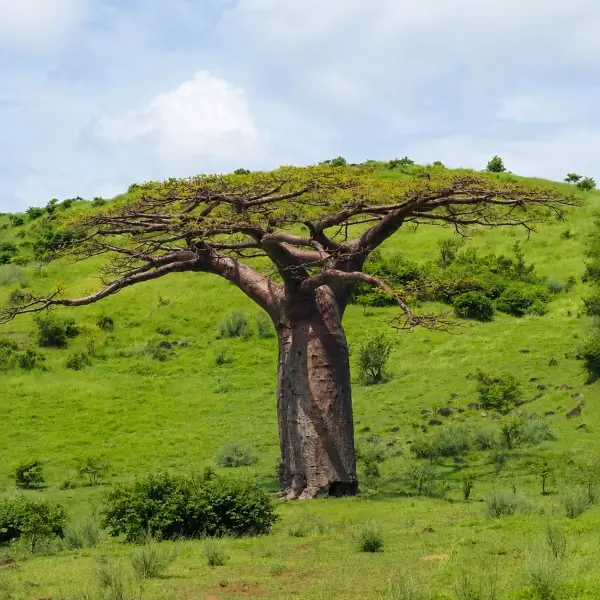
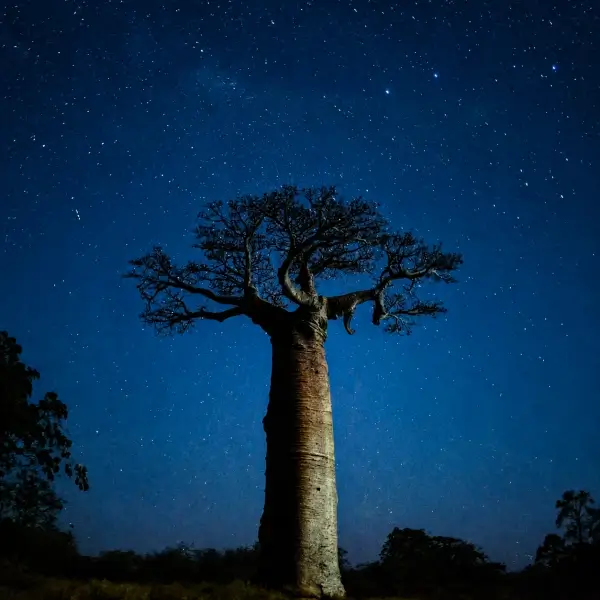
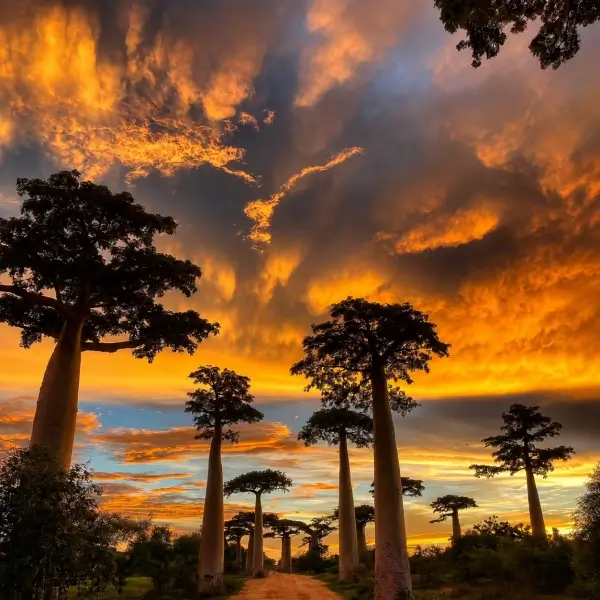
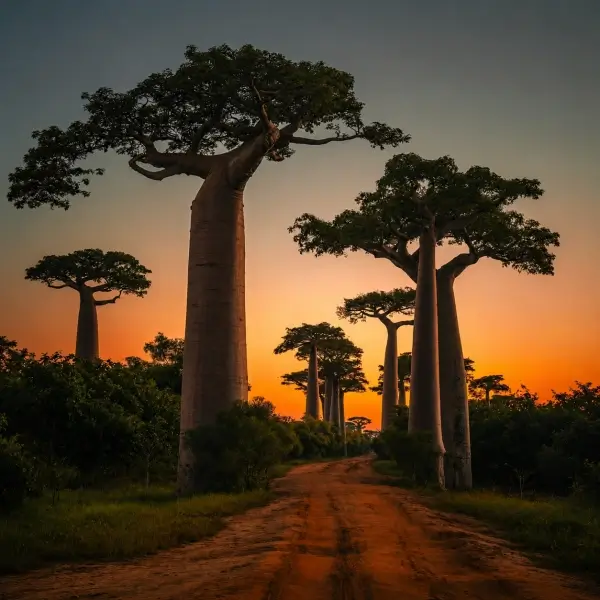
A mature African baobab tree often grows only 10 to 25 metres high, but height is the wrong measurement by which to judge it. Its trunk can become several metres across, while the crown may spread more than 20 metres. Grey bark covers thick branches that divide into a sparse framework resembling an exposed root system.
The leaves explain the species name. Digitata refers to their hand-like form: usually five to seven leaflets radiate from a central point like fingers from a palm. They appear when seasonal conditions become favourable and are shed as the long dry period returns, reducing water loss.
Baobab wood is soft, fibrous, and rich in living tissue. Its trunk functions as both support and a moisture reserve, not as a hollow tank filled with free water.
How the African Baobab Tree Handles the Dry Season
The swollen trunk is the most visible drought adaptation, but it does not work alone. During the rainy season, the tree takes up water and its tissues become more hydrated. As conditions dry, stored moisture supports living tissues and seasonal growth, while leaf fall sharply reduces transpiration. The tree does not attempt to maintain a full green crown through the harshest months.
Its fibrous bark can regenerate after limited damage. This matters where fire, browsing animals, and harvesting injure trunks. Elephants may tear into baobabs for moist tissue, yet established trees can survive wounds that would girdle less resilient species.
This differs from the Euphrates poplar, which follows rivers and groundwater through arid landscapes. The poplar depends on adaptable roots and access to groundwater; the baobab combines leaf loss, water-rich wood, bark, and broad roots. Both survive drought through different designs.
Why It Is Called the Upside-Down Tree
For much of the dry season, the bare crown looks startlingly root-like, as though the tree had been pulled from the earth and replanted upside down. African stories have given many explanations for this form, turning an ecological adaptation into a recognizable natural legend.
At the beginning of the growing season, fresh leaves rapidly cover branches that appeared lifeless. By remaining nearly leafless when evaporative demand is high, the tree waits until water and temperature again permit active growth.
This is why the baobab’s strength can be misleading. It survives not by remaining unchanged, but by changing its activity with the season. Its apparent stillness is part of its biology.
One Night of Flowers and a Regional Pollination Story
The flowers are among the most spectacular parts of the African baobab tree. Round buds hang from long stalks. Late in the day, white petals open around a dense ball of stamens. A flower may reach roughly 20 centimetres across, yet it opens around dusk and usually fades or falls within about 24 hours.
Older accounts describe the species simply as bat-pollinated, but current research shows a regional pattern. A continent-wide study found the fruit bat Eidolon helvum to be the main visitor in West Africa and Rousettus aegyptiacus in East Africa. Researchers observed no bats in the southern populations studied, where moths were frequent instead. Flower form, nectar, and scent also differed in ways that matched these visitors. Oxford Academic study on regional baobab flower visitors and floral traits
White petals are visible in low light, while scent and nectar guide visitors. A feeding bat or moth contacts the reproductive parts and can carry pollen to another tree. Because the species is self-incompatible, fruit production depends on pollen moving between compatible individuals. The evidence replaces a simple “bat flower” story with a regional network of bats and moths.
From Hanging Fruit to the Next Generation
After pollination, pendulous fruit takes months to mature. Each develops a hard, woody shell, often covered with yellow-brown hairs. Inside, dry pale pulp surrounds many dark, kidney-shaped seeds. The shell protects the contents while the fruit remains on the tree or ground.
Animals and people help move the seeds. Monkeys and baboons open fruit, wildlife scatters material, and humans have transported baobab seed along settlement and trade routes for generations. The hard seed coat permits dormancy until abrasion, digestion, fire, or deliberate treatment improves germination.
Young stems begin relatively slender and become conical or bottle-shaped with age. Rainfall, soil, disturbance, and competition influence growth, so trunk diameter cannot be converted into age with a simple formula. The famous swollen form is the product of long development.
A Tree Used From Fruit to Fibre
The nickname “monkey-bread tree” refers to the edible pulp. It can be eaten or mixed into porridge and drinks; leaves are cooked or ground for soups; and seeds may be roasted, pressed for oil, or used as an ingredient. These are traditional foods, not evidence that every health claim made about baobab is medically proven.
The inner bark provides fibre for rope, baskets, mats, and nets. It can regenerate after careful harvesting, although repeated cutting still causes harm. Hollow or modified trunks have served as storage spaces and water containers. Broad crowns offer shade, making old trees natural places for rest, markets, and meetings.
The South African National Biodiversity Institute documents the tree’s morphology, night flowers, fruit, ecology, and many long-established human uses. PlantZAfrica profile of Adansonia digitata
How Scientists Measure a Life Without Clear Rings
Dating an African baobab tree is difficult. Its fibrous wood lacks the clear annual rings familiar from many temperate species. Old baobabs may also consist of several stems fused into a ring, sometimes enclosing a false cavity. A core from one position may record only one stem rather than the entire organism.
Researchers use accelerator mass spectrometry radiocarbon dating on small samples from selected trunks, branches, cavities, or damaged surfaces, interpreting the results alongside the tree’s architecture. This is more reliable than estimating age from diameter.
A 2026 study of four huge baobabs near Xangongo, Angola, found every tree was multi-stemmed. XG-1 had 11 fused stems and an estimated age of 2,100 ± 50 years, making it the oldest accurately dated living African baobab reported by the team. That supports a lifespan measured in millennia, but not the claim that every 10-metre trunk must exceed 4,000 years. Cambridge University Press radiocarbon study of the Xangongo baobabs
The comparison with the coast redwood and its documented record of height and longevity is revealing. A redwood expresses endurance through dense wood, extreme height, and a moist coastal climate. A baobab expresses it through width, multiple fused stems, seasonal dormancy, and life in a dry tropical landscape. There is no single design for an ancient tree.
The African Baobab Tree as a Lesson in Survival
The baobab appears permanent, but seedlings still need safe places to establish and flowers need the right nocturnal visitors. Old trunks can recover from some damage but not unlimited pressure. Drought tolerance does not make the species immune to land conversion, overharvesting, disrupted pollinator communities, or rapid climatic change.
Its deeper lesson is that endurance is dynamic. It sheds leaves rather than wasting water, opens flowers when pollinators are active, protects seeds inside a durable shell, and adds stems as older structures age. For a wider view of how establishment, maturity, and old age shape trees, see The Life Cycle of a Tree.
The African baobab tree is therefore more than a strange silhouette on the savanna. It is a living system in which water, wood, animals, people, and time are closely connected. Its bottle-shaped trunk may first attract attention, but the real wonder lies in the processes behind it: patient growth, seasonal restraint, brief flowers, regional pollinators, useful fruit, and a body capable of carrying more than two thousand years of change.