Why the Euphrates Poplar Thrives Where Few Trees Can
The Euphrates poplar, scientifically known as Populus euphratica, is one of the most remarkable trees of the world’s arid landscapes. It survives where few large plants can endure: beside shifting deserts, on saline floodplains, and across river corridors exposed to scorching summers, freezing winters, drought, and periodic flooding. Its strength does not come from resisting every environmental change in the same way. Instead, the tree alters its roots, leaves, and growth according to the conditions around it.
This extraordinary flexibility has allowed the species to form sparse but ecologically important forests across Central Asia, the Middle East, northwestern Africa, and western China.
The Euphrates Poplar at a Glance
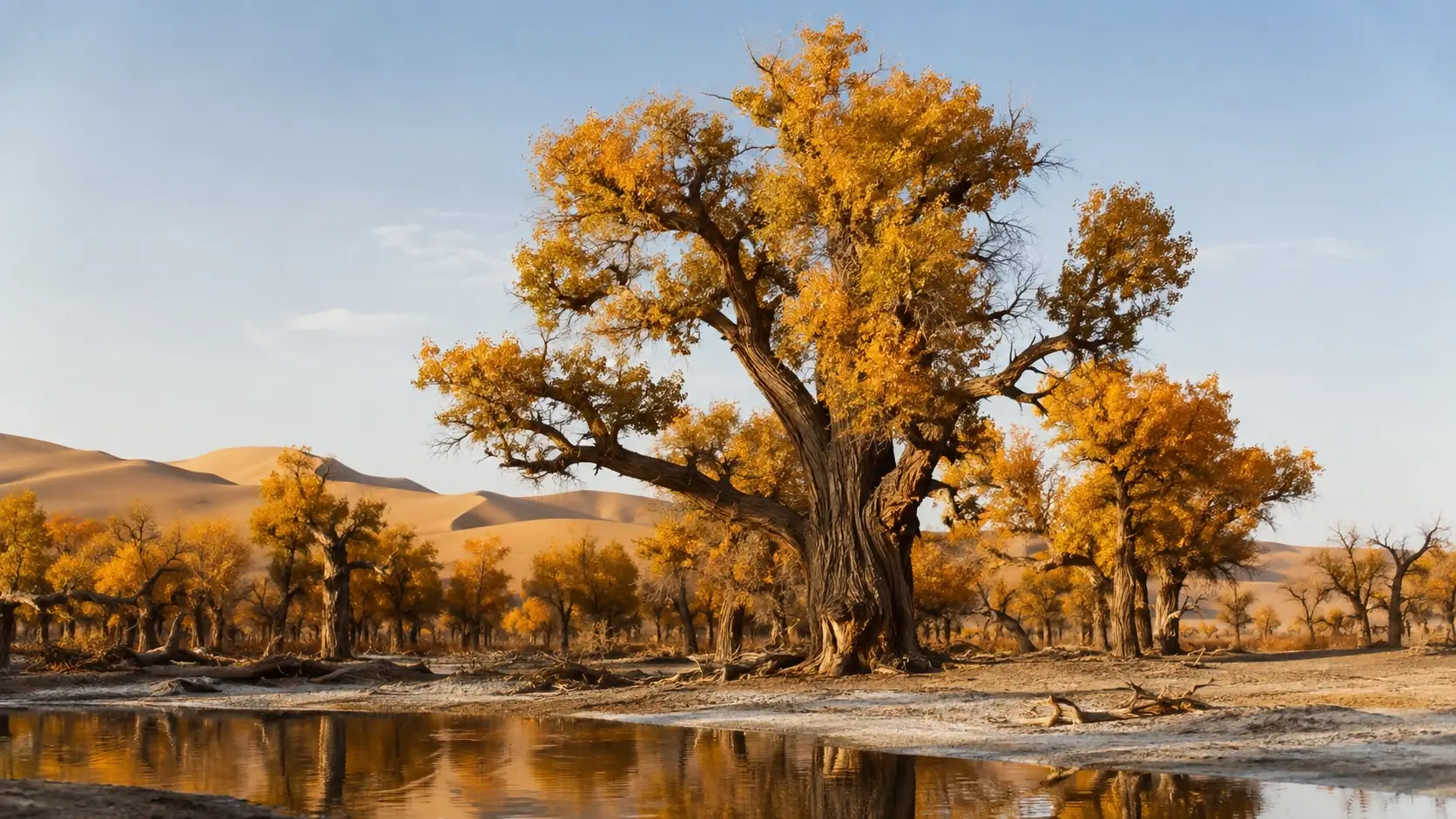
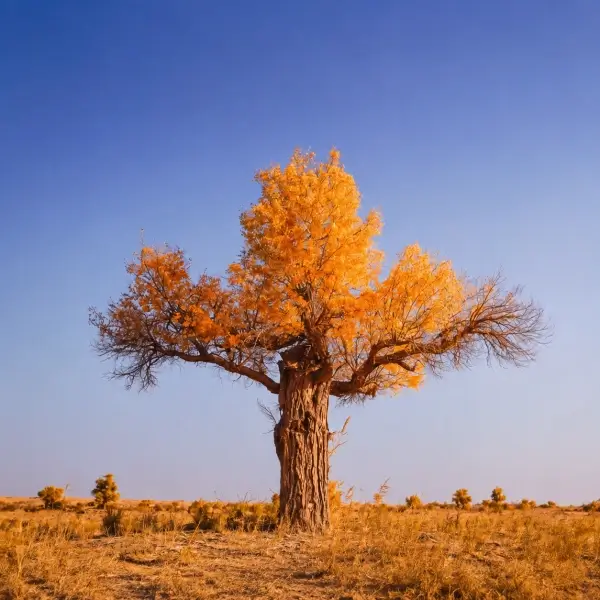
The Euphrates poplar belongs to the willow family, Salicaceae. It is a deciduous tree that commonly reaches about 15 meters in height, although its appearance varies considerably with age, water availability, soil conditions, and exposure to wind.
Older trees often develop broad, irregular crowns, thick branches, twisted trunks, and deeply fissured gray-brown bark. These rugged forms reflect the difficult conditions in which they grow.
The species is dioecious, meaning that male and female flowers grow on separate trees. Both appear in elongated flower clusters known as catkins. After pollination by wind, the female trees produce small capsules containing tiny seeds surrounded by silky hairs. These hairs help the seeds travel through the air and across exposed ground.
The seeds can germinate quickly on moist, newly deposited soil after a flood. However, the favorable conditions may last only briefly. In established forests, natural regeneration also occurs through roots and root suckers, allowing groups of genetically connected trees to develop around older individuals.
A Range Extending Across Continents
According to the Royal Botanic Gardens, Kew, the native range of Populus euphratica extends from North Africa through the Middle East and Central Asia to Mongolia and the western Himalayas. The species has also been introduced into Egypt and Spain.
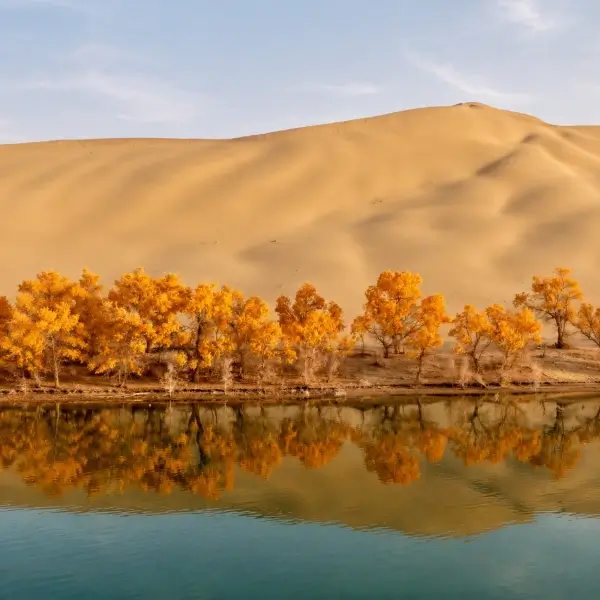
Its most extensive natural forests are now found in China. The Tarim Basin in Xinjiang contains the world’s largest continuous distribution zone of natural Euphrates poplar forest. A UNESCO World Heritage Centre assessment reports approximately 352,200 hectares of these forests in the basin.
The trees generally follow rivers, seasonal channels, lakes, and places where groundwater is accessible. From a distance, a forest may appear open and widely spaced, with thorny shrubs, reeds, salt-tolerant plants, and exposed ground between the trees. Yet these apparently sparse woodlands form a vital green corridor through an otherwise extremely dry landscape.
How the Euphrates Poplar Adapts to Extreme Conditions
The survival of the Euphrates poplar depends heavily on its adaptable root system. In dry desert soils, roots may extend widely and reach deep underground water. Where soil remains wetter, a greater proportion of roots can develop closer to the surface, helping the tree remain stable and absorb recently available moisture.
This adaptability enables the tree to survive alternating periods of flooding and prolonged drought. Floodwater can create new germination sites, while established roots allow mature trees to endure after surface water disappears.
Salt is another major challenge. Water evaporates rapidly in arid regions, leaving dissolved minerals behind and gradually increasing soil salinity. Research published in Frontiers in Plant Science explains that P. euphratica coordinates water transport, water use, and water retention when growing under saline conditions.
The tree can regulate ions, protect cellular functions, and maintain access to water even when the surrounding soil becomes difficult for most other trees. These abilities make it exceptionally salt tolerant, but not invulnerable. Severe or prolonged water loss can still reduce growth, prevent seedling establishment, and eventually kill entire stands.
Many Leaf Shapes on a Single Tree
One of the tree’s most distinctive characteristics is heterophylly—the development of differently shaped leaves on the same plant.
Young shoots and lower branches commonly carry narrow, lance-shaped leaves. The middle crown may produce broader oval leaves, while mature upper branches often bear wide, toothed leaves. Leaf shape may therefore vary with both the position of the leaf and the age of the branch.
These differences are not merely decorative. Studies of heteromorphic leaves in Populus euphratica indicate that leaf structure is connected to the tree’s responses to drought, salinity, light, and water transport.
Narrow leaves can limit surface exposure during vulnerable stages of growth, while broader mature leaves provide more area for photosynthesis when the tree has developed a stronger water supply. Together, the different leaf forms help the Euphrates poplar function across changing conditions within the same environment.
Floods, Seeds, and Root Suckers
Although this species is famous for surviving drought, flooding remains essential to its life cycle. Floodwater carries seeds, moistens exposed sediment, and creates bare surfaces where seedlings can establish without intense competition.
The window for seed regeneration is narrow. The soil must remain wet long enough for the new root to grow toward a dependable water source. If the ground dries too rapidly or the groundwater level falls, young seedlings may die even when nearby mature trees survive.
Root suckers provide another route to regeneration. Shoots emerge from an established underground root network and develop into new trunks. The World Agroforestry species profile records both seeds and root suckers as natural methods of reproduction. This clonal growth helps existing populations persist, although healthy seed regeneration remains important for maintaining genetic diversity.
Ecological and Traditional Human Uses
In places with limited pasture, the leaves have traditionally been used as fodder for sheep, goats, and camels. The light, moderately hard wood has been used for boards, boxes, plywood, turned objects, fuel, and paper pulp.
Some communities have also used parts of the tree in traditional remedies. Such uses should be described as ethnobotanical traditions rather than clinically proven medical treatments.
Ecologically, the tree is even more valuable. Its roots stabilize riverbanks, hold loose soil, and reduce wind erosion. Its crown provides shade and shelter, while its presence creates habitat for insects, birds, mammals, and smaller desert plants.
Because it tolerates saline ground, the species has also been planted in windbreaks and land-restoration projects. These applications make the tree useful for reducing sand movement and helping protect agricultural land near desert margins.
Why These Forests Are Under Pressure
Extreme natural conditions are not the only challenge facing these trees. Agricultural irrigation, river engineering, groundwater extraction, fuelwood harvesting, and land conversion can alter the water systems upon which the forests depend.
When too much water is diverted upstream, less reaches the middle and lower sections of desert rivers. Groundwater falls, surface soils become drier, and salt may accumulate. Mature trees can survive these changes for some time, but seedlings and young trees are far more vulnerable.
The FAO’s assessment of forest genetic resources identifies changes to hydrological regimes, clearance, and overharvesting as major causes of decline across the species’ range.
Effective conservation therefore requires more than protecting individual trees. It depends on maintaining environmental water flows, preserving floodplain connections, limiting destructive harvesting, and monitoring natural regeneration. Without periodic water and successful recruitment, an apparently healthy forest may gradually become a landscape dominated by aging trees.
A Living Symbol of Desert Resilience
The Euphrates poplar demonstrates that resilience is not simple resistance. Its survival depends on flexibility—changing its leaves, extending its roots, responding to floods, and managing water and salt under difficult conditions.
Yet even this exceptionally adaptable tree depends on functioning rivers and responsible water management. Protecting the Euphrates poplar means protecting an entire desert ecosystem, including the soil, wildlife, river corridors, and human communities that depend on it.
Its twisted trunk and many-shaped leaves tell the same story: life survives not by remaining unchanged, but by learning how to grow through change.