Why Western Redcedar Is One of the Forest’s Great Survivors
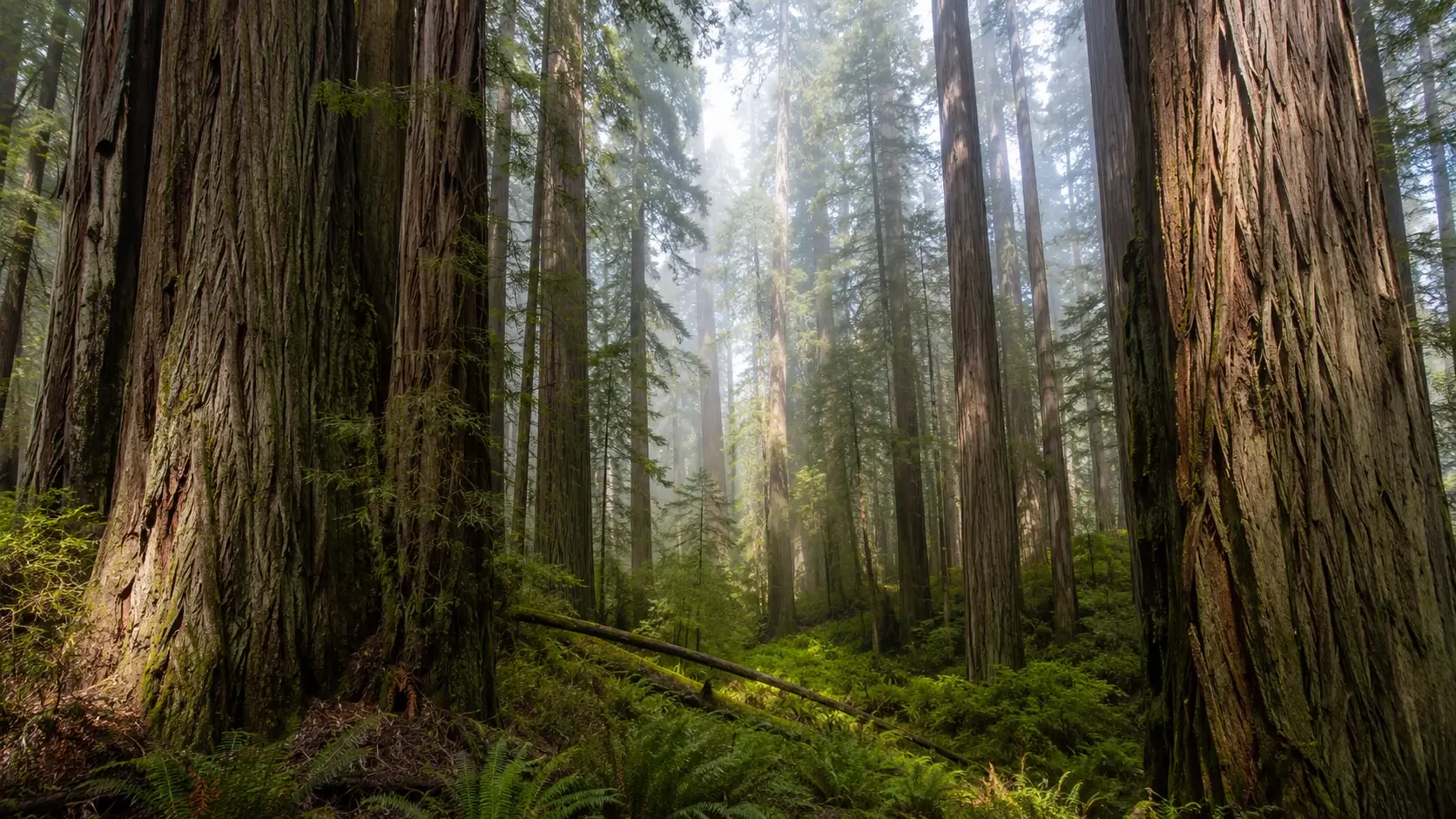
Few conifers combine monumental size with quiet adaptability as completely as western redcedar (Thuja plicata). In the cool, moist forests of western North America, it can rise beyond 60 meters, wait beneath taller neighbors for decades, colonize disturbed ground by seed, and reproduce when a low or fallen branch takes root. These options have made it a signature tree from southeastern Alaska to northern California and a successful planted species overseas. Yet thin bark, shallow roots, edible foliage, fungi, and specialist insects reveal where this forest giant remains vulnerable.
A Giant That Is Not a True Cedar
Despite its common name, western redcedar is not a true cedar of the genus Cedrus. It belongs to the cypress family, Cupressaceae, and is the only Thuja species native to western North America. The joined form “redcedar,” often used by North American forestry authorities, helps signal that botanical distinction.
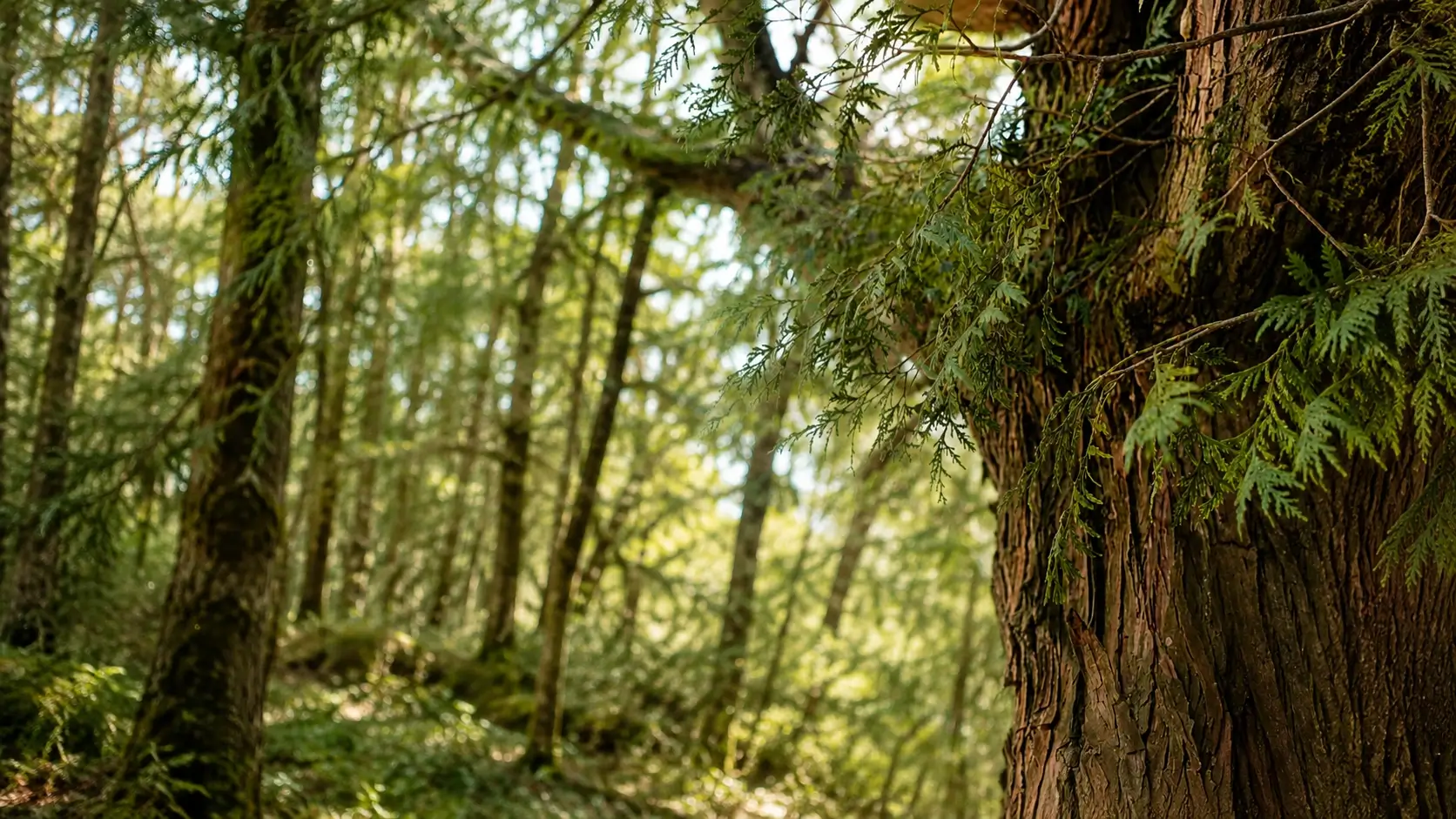
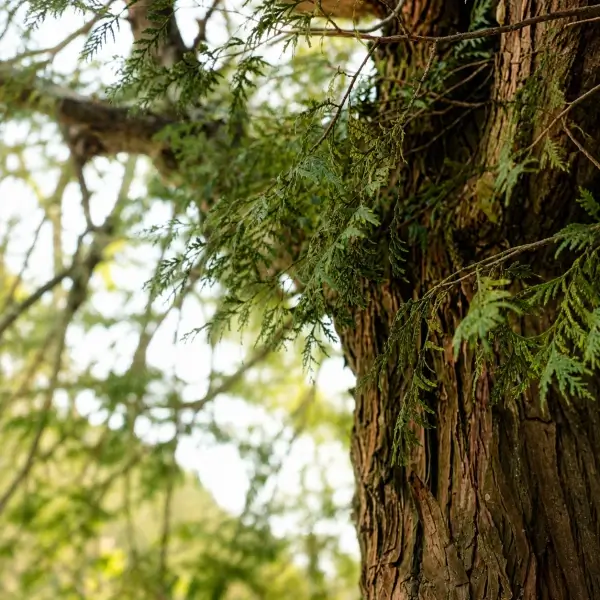
A young tree normally has a narrow pyramidal outline. With age, the crown becomes more columnar and the base may broaden into a tapered or fluted structure. Thin, reddish-brown, fibrous bark separates into long strips. Low branches spread or droop before turning upward at their ends.
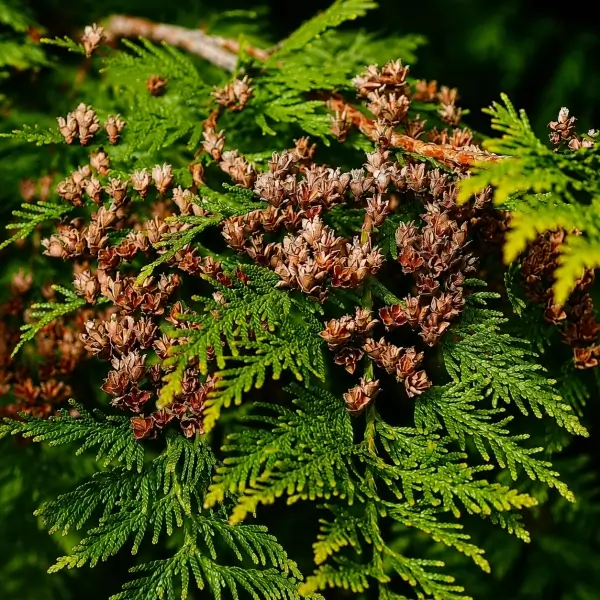
Tiny, overlapping, scale-like leaves form flattened sprays. They are glossy green above and commonly carry pale butterfly-shaped markings below. Crushed foliage releases a distinct scent. The pollen structures are small and reddish; the upright woody seed cones are usually about 12–13 millimeters long.
The species is monoecious, meaning one tree carries both pollen and seed structures on different branches. Reddish pollen structures tend to occur lower in the crown, while green female structures form higher and farther from the trunk. Mature cones release numerous small, winged seeds in autumn. This reproductive arrangement adds another contrast to the tree’s immense scale: an organism weighing many tonnes begins with a seed light enough to travel on the wind.
Cultivated trees are often smaller than Pacific rainforest giants, but exceptional wild specimens can exceed 60 meters and may approach 70 meters. Individuals can live for 800 to 1,000 years or longer, shaped by wet soil, shade, storms, competition, and decay.
Where Western Redcedar Finds Its Best Climate
The coastal native range runs from southeastern Alaska through British Columbia, Washington, and Oregon to northern California. A separate inland range crosses parts of British Columbia, northern Idaho, western Montana, and northeastern Washington. Elevation extends from sea level to more than 2,000 meters at some southern or inland limits.
Its preferred climate has cool or cloudy summers, wet mild winters, high humidity, and dependable soil moisture. It is abundant on riverbanks, ravines, seepages, and poorly drained bottomlands, yet also grows on well-drained slopes where rainfall is sufficient. For comparison, the bald cypress survives flooded wetlands through different adaptations in southeastern North America.
The species grows on clay, loam, organic soil, rocky ground, and even shallow soil over chalk, tolerating acidic and alkaline conditions. Climate is less negotiable. Seedlings can be injured by drought, hot soil, direct exposure, and unseasonable frost. Even where established trees endure severe inland winters, late freezes may damage fresh growth.
Kew records the tree as introduced across much of northern and western Europe. Its success there reflects the same preferences visible at home: cool conditions, adequate moisture, and room for a large evergreen crown.
The Useful Hedge Some Gardeners Love to Hate
A clipped conifer wall can be dismissed as monotonous, and western redcedar hedges sometimes receive that criticism. As screening, however, dense evergreen foliage, low branching, fast growth on suitable sites, and tolerance of trimming are highly practical.
A planted row can reduce wind and block views throughout the year, either as a formal hedge or a tall shelter belt. Its vigor demands planning: an unmanaged tree can become enormous, so spacing, moisture, and long-term pruning matter. The supposedly ordinary hedge is a controlled expression of a rainforest tree’s scale.
How Shade Tolerance Changes the Competition
Western redcedar is among the most shade-tolerant conifers in its native forests. The USDA Forest Service ranks only Pacific silver fir, western hemlock, and Pacific yew as more tolerant in the region. Under a dense canopy it may grow very slowly, yet remain alive after more light-demanding species fail.
A small tree can persist until a fallen branch, dead neighbor, or disturbance opens the canopy, then respond to increased light. On open, moist, fertile sites, young trees can grow rapidly; under deep suppression, they may remain small for a very long time. Their advantage is the ability to shift between waiting and expansion.
Partial shade can protect seedlings from heat and water stress, while excessive shade may restrict roots. Bare mineral soil, rotting wood, and other moist surfaces offer seedbeds. This reflects the wider biology of how trees actually grow: light, water, nutrients, roots, and neighbors interact.
Seed production also explains how the species appears after disturbance. Heavy crops are common, and wind can distribute seed effectively around a parent stand, even though the seeds usually travel less far than those of western hemlock, Sitka spruce, or Douglas-fir. Clearings expose mineral soil and increase light, creating opportunities for sexual reproduction. Closed, continuously moist old forest favors vegetative reproduction instead. The tree therefore uses disturbance rather than merely enduring it, changing its reproductive method with the structure of the forest.
Western Redcedar Regeneration Does Not Depend on Seed Alone
Seed is only one path to a new tree. Three forms of vegetative reproduction are documented: layering by attached low branches, rooting by fallen branches, and upright branch growth on fallen trunks. In a wet, shaded forest, these routes may be more reliable than exposed seed.
Layering begins when a flexible lower branch touches damp ground and roots while still connected to its parent. Fallen branches may root independently, while branches along a downed living trunk can turn upward. The result may be a group of stems connected by older wood across the forest floor.
This is clonal regeneration: living tissues create rooted stems with the same genetic origin. The tree generally lacks a strongly defined taproot and instead develops a dense network of fine roots. Roots are often shallow in saturated or compacted ground. Moisture enables rooting while also contributing to instability and fire sensitivity.
Why Its Heartwood Resists Decay
The heartwood’s natural durability comes partly from extractives called thujaplicins. One, beta-thujaplicin, is also known as hinokitiol. Their antifungal activity helps explain the wood’s use for shingles, siding, posts, boats, and other moisture-exposed products.
Hinokitiol is not simply found only in the “sap of mature trees.” Research concerns heartwood extractives whose abundance varies with age, trunk position, and individual. Experiments also show that heartwood-inhabiting fungi can sharply reduce thujaplicin levels. Durability therefore depends on several compounds and conditions, not one shield.
The living tree is not immune. More than 200 fungi have been recorded on the species, though it is less susceptible to many attacks than several forest associates. Seedlings may suffer foliage disease, while older trees develop root, butt, or trunk rots. The evidence does not show that a young tree automatically heals once hinokitiol appears; resistance varies, and decay may coexist with centuries of growth.
Fire Browsers and Borers Reveal Its Limits
Western redcedar has low to moderate fire resistance. Thin bark, flammable foliage, low branches, and surface roots expose young trees. Large old trees sometimes survive when fire neither girdles their trunks nor severely scorches their crowns, but size only reduces risk.
Black-tailed deer browse seedlings and saplings year-round in parts of British Columbia, while Roosevelt elk feed on them from autumn through spring. When winter alternatives are scarce, repeated browsing can become a major obstacle to stand establishment.
The western redcedar borer (Trachykele blondeli) tunnels through bark and wood. Gall midges damage seed, leaf blight can kill nursery stock, and root or trunk rots affect older trees. Wet sites may also increase windthrow where rooting stays shallow. Each threat attacks a different part of the tree’s strategy.
What This Tree Teaches About Resilience
The success of western redcedar comes from flexibility rather than perfect defence. It uses seed after disturbance and clonal growth under closed canopy, tolerates deep shade yet accelerates when light returns, occupies wet and well-drained sites, and produces decay-resistant heartwood. These qualities support it in the Pacific Northwest and in cool regions overseas.
Fire exploits thin bark, low branches, and surface roots. Deer and elk suppress young trees. Borers and fungi penetrate durable tissues, while saturated ground can weaken its hold. Like the question of whether trees have a lifespan limit, its survival has no single miraculous explanation.
Western redcedar endures because it has several imperfect solutions operating together. It waits, spreads, roots, resists, and begins again. That is the deeper meaning of forest resilience: not freedom from damage, but enough biological options to continue after conditions change.