The Biological Cyborg
The General Sherman tree—the largest living organism by volume—is technically 98% dead. Yet, at this very moment, it is actively growing, breathing, and quietly drinking water. To understand how do trees grow while being mostly inanimate, we have to look back 470 million years. When the first primitive plants crawled onto land, they were barely 10 centimeters tall, carpet-like structures vulnerable to the slightest breeze
It wasn’t until 360 million years ago that plants unlocked an evolutionary superpower: lignin. Acting like a carbon-fiber armor, lignin transformed soft cell walls from a jelly-like state into a granite-hard structure. This single adaptation allowed plants to shoot upward, beginning an evolutionary arms race that led to Hyperion, a Coast Redwood standing at a staggering 115 meters tall.
The Ultimate Sacrifice: Why 98% of a Tree is Dead
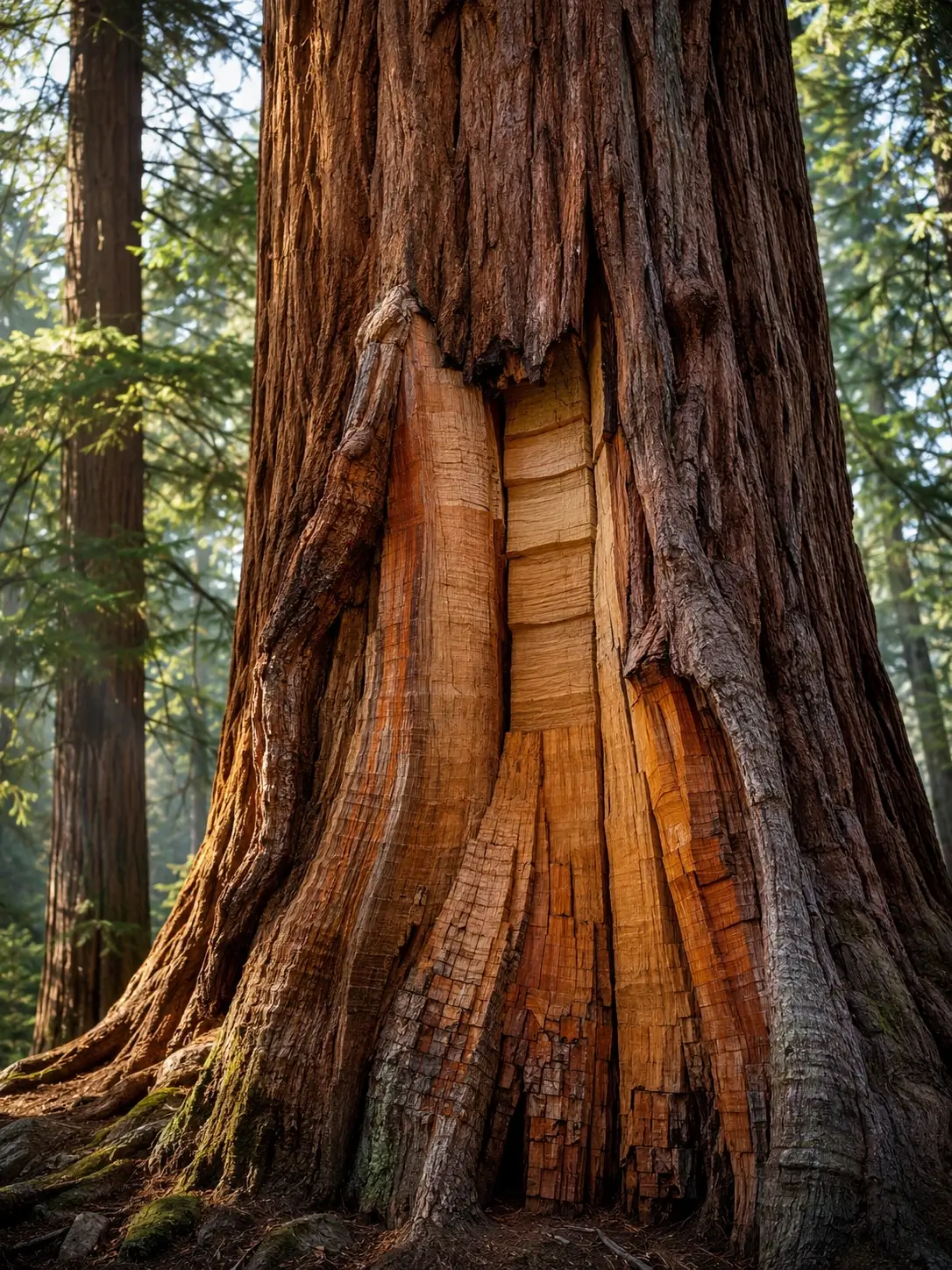
To achieve these towering heights, trees developed a bizarre survival strategy: they intentionally kill their own cells. The vast majority of a tree trunk consists of dead cell remnants stacked together like concrete blocks, reinforced by a “steel rebar” of lignin.
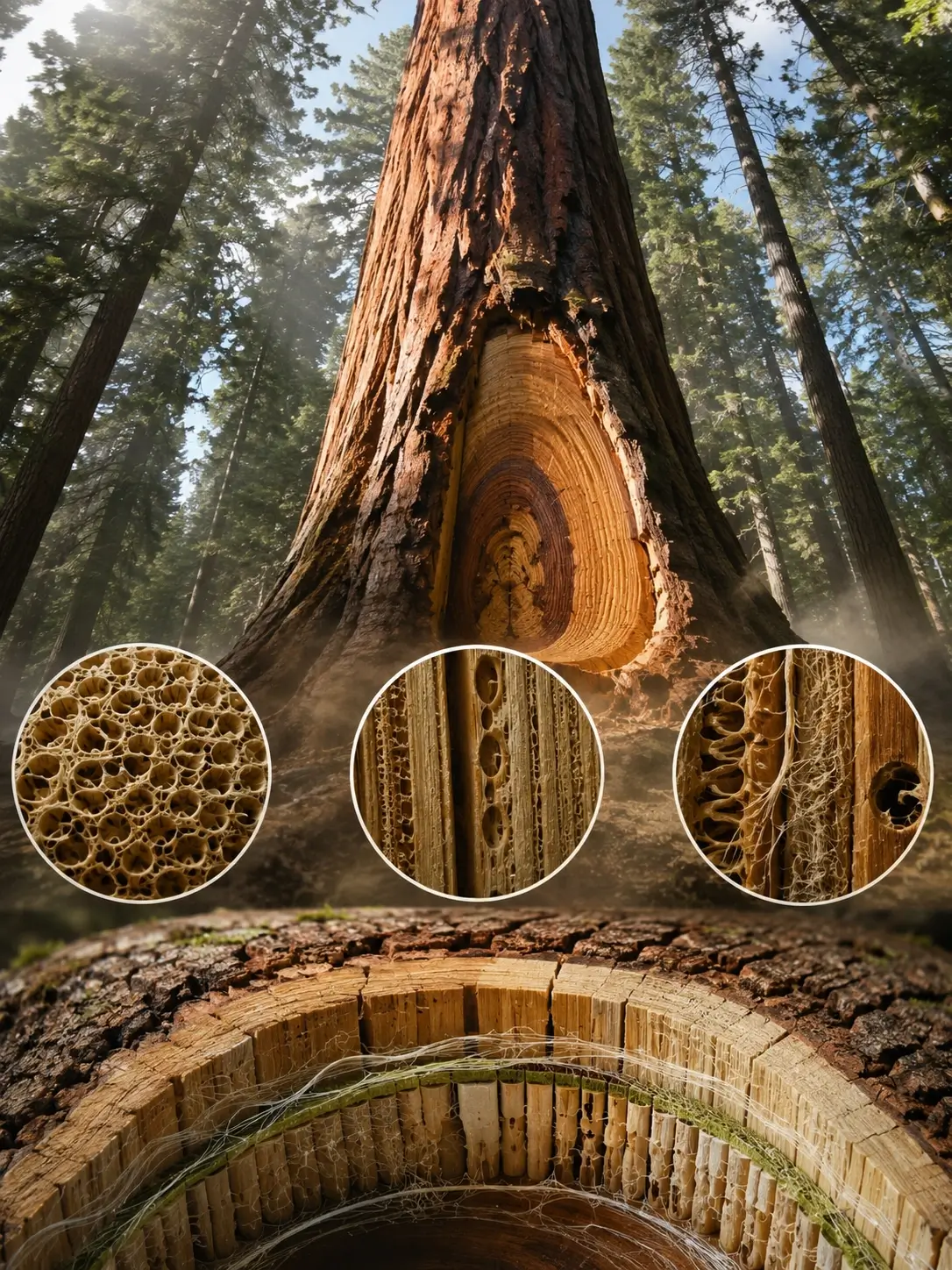
Ultimately, only a thin outer layer of the tree remains biologically alive. If you were to slice open a tree trunk, you would discover three highly specialized mechanical workshops that keep this giant factory running.
1. The Cambium: The Stem Cell Factory
Hidden between the bark and the wood lies the cambium. At just 0.1 mm thick—thinner than a sheet of A4 paper—this microscopic layer is a biological perpetual motion machine. It constantly divides, pushing dead xylem cells inward to create solid wood and pushing phloem cells outward to transport nutrients. Some ancient trees feature cambium layers that have been continuously dividing for over 5,000 years.
2. The Xylem: The High-Pressure Water Highway
Because 98% of a tree is dead, these hollowed-out, dead xylem cells are free to form the most efficient water pipelines on Earth. To understand how trees transport water up a 100-meter-tall canopy, imagine overcoming 10 atmospheres of pressure without a mechanical pump.
Trees solve this through transpiration. As water evaporates from microscopic pores (stomata) in the leaves, it creates a powerful negative pressure, pulling water upward from the roots like someone drinking through a giant straw. A mature tree can pull up to 200 liters of water daily.
3. The Phloem: The Nutrient Delivery Network
While the xylem acts as the water main, the phloem functions as the tree’s internal delivery service. Composed entirely of living cells, the phloem transports glucose produced via photosynthesis in the leaves down to the roots and fruits. This nutrient stream moves at an impressive speed of up to one meter per hour.
Internal Workings of a Tree Trunk
The table below outlines how these distinct layers work together to sustain a tree’s massive structure:
| Trunk Layer | Cell Status | Primary Function |
| Cambium | Living | Stem cell production; generates new xylem and phloem |
| Xylem | Dead | How trees transport water and minerals from roots to canopy |
| Phloem | Living | Distributes sugars and nutrients from leaves downward |
| Bark (Outer) | Dead | Mechanical protection against pests, fire, and weather |
Eternal Life: The Genetically Immortal Super-Plants
Now we can answer the ultimate question: how can an organism thrive when 98% of a tree is dead? Because a tree’s core structural mass is already dead, it requires very little metabolic energy to maintain. The tree only needs to keep its “skin” (the cambium and phloem) and its roots alive.
Theoretically, if the cambium remains undamaged by external forces, a tree possesses potential immortality. Consider these mind-boggling examples of the oldest trees on Earth:
- Methuselah (Great Basin Bristlecone Pine): Located in the White Mountains of California, this individual tree is estimated to be over 4,600 years old.
- Old Tjikko (Norway Spruce): Located in Sweden, this tree’s vegetative root system has been carbon-dated to an astonishing 9,550 years old, meaning it has been growing since the last Ice Age.
The Vulnerability of Giants
Despite their evolutionary mastery, trees are not completely immune to time. Recent studies show that trees over 200 years old can exhibit a form of “senescence syndrome”—their growth rate slows, and their immune systems weaken against pests. However, compared to mammals that rarely breach a century, trees have undeniably won the evolutionary lottery.
The next time you lean against a massive tree trunk, remember that you are resting against a skyscraper built from the scaffolding of billions of dead cells—a highly optimized, ancient biological factory. While humans rush through generations, these stationary giants continue their slow, silent conquest of time.