Bunya Pine Links Ancient Forests with Cultural Heritage
The bunya pine is one of Queensland’s most memorable trees, with a towering trunk, a rounded crown and enormous cones filled with edible seeds. Yet its importance reaches beyond its appearance. This Australian conifer brings together forest ecology, Aboriginal cultural connections and an unusual way of beginning life underground. Understanding it means looking at both the tree itself and the relationships that have helped shape its story.
For readers interested in remarkable trees, it offers a compelling example of how food, landscape and human history can meet in a single species.
What Makes the Bunya Pine Recognizable
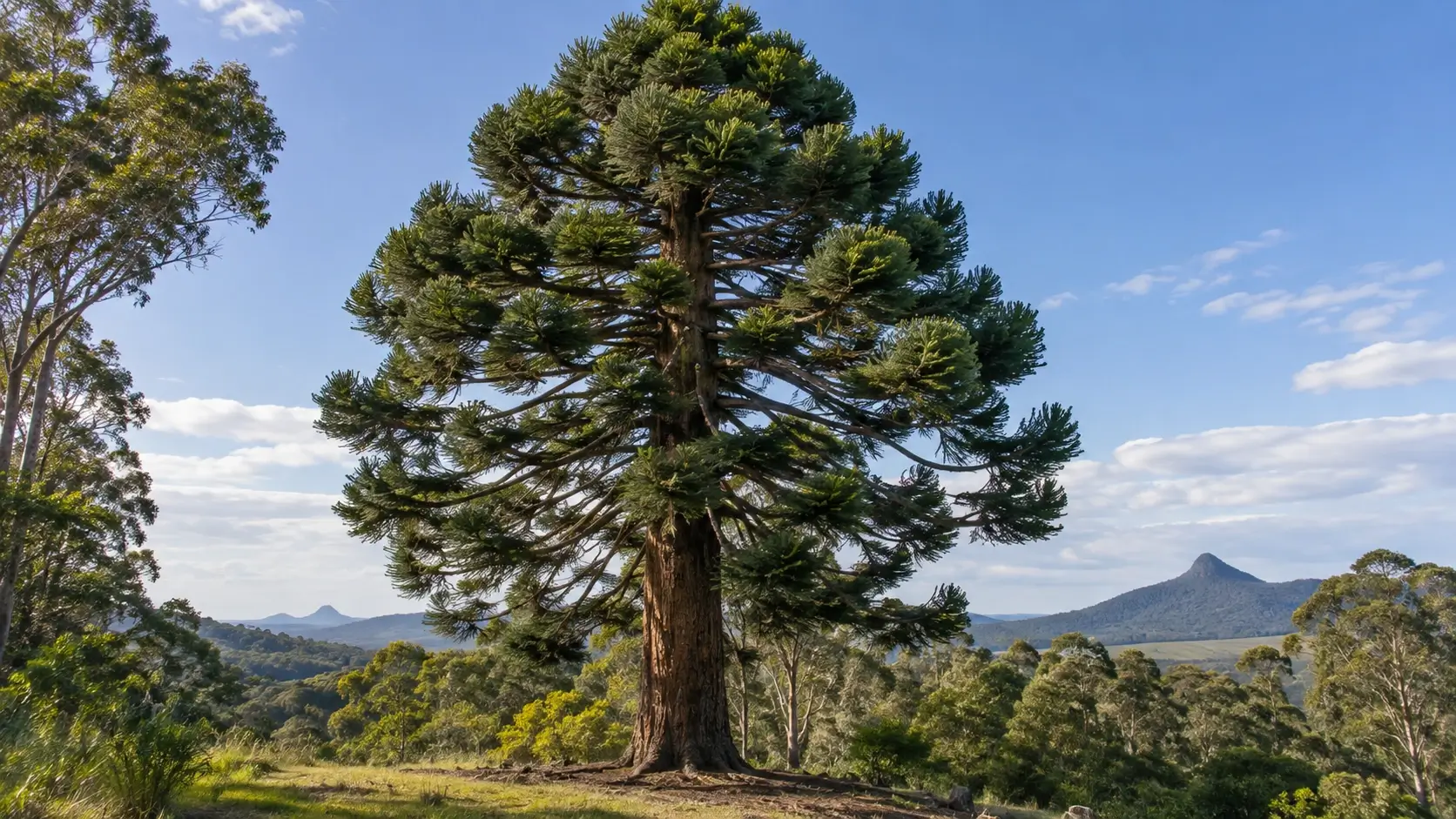
Known scientifically as Araucaria bidwillii, this evergreen belongs to the Araucariaceae family. Despite its common name, it is not a true pine of the genus Pinus. It is related to other araucarias, including the familiar monkey puzzle tree.
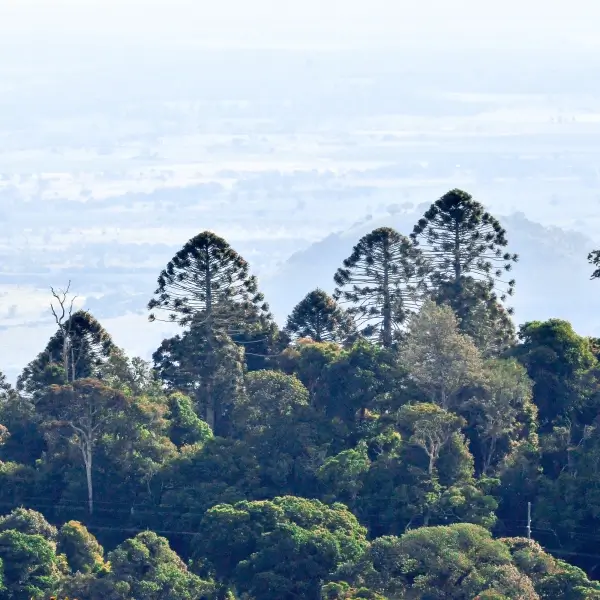
Young specimens have a roughly pyramidal outline. As they mature, their crowns become broader and more dome-shaped, with dense foliage concentrated toward the ends of the branches. Dark bark, strong horizontal branching and glossy, pointed leaves give the tree a distinctive silhouette.
It can reach approximately 30–45 metres in height, although larger individuals occur. Leaf appearance varies with growth stage and growing conditions, so a single leaf measurement is less useful than the combination of crown shape, branching and foliage. The Gymnosperm Database species profile provides a detailed botanical description.
Where These Trees Grow Naturally
The natural home of the bunya pine is Queensland, Australia. Its distribution includes southeastern Queensland and small, geographically separated populations in the far north. The Bunya Mountains are especially closely associated with the species, but they do not represent its entire native range.
This is a rainforest tree, which helps explain why moisture matters to its ecology. Its native setting is very different from the dry, open landscape that the word “pine” may suggest to some readers.
Natural distribution also needs to be distinguished from cultivation. A tree growing in a park outside Queensland may be an established ornamental specimen rather than evidence of a native population. That distinction matters when discussing how widespread a species is or how its forests have changed.
Giant Cones Hold a Generous Harvest
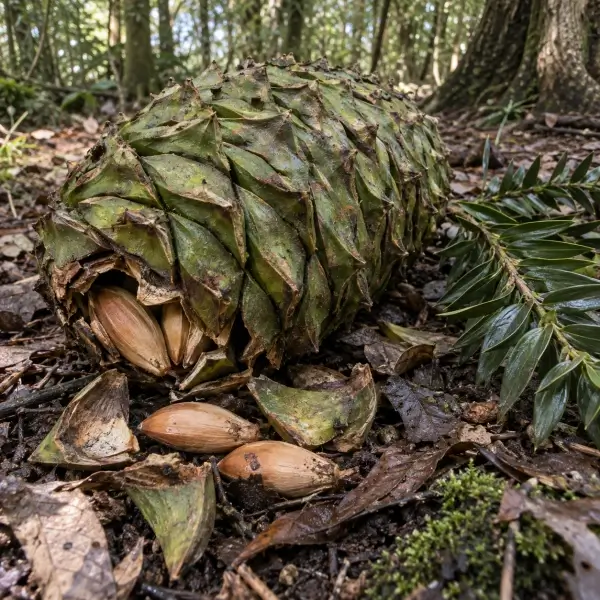
The most dramatic feature of the bunya pine is its seed cone. Large, green and roughly oval, it resembles a heavy ball suspended high above the ground. These structures are cones rather than botanical fruits, and the “nuts” inside are seeds.
Each cone can contain dozens of substantial seeds. Once a mature cone reaches the ground and breaks apart, those seeds become available to animals or may begin developing where conditions allow.
Their weight deserves respect. Queensland Parks warns that cones weighing up to 10 kilograms can fall during the December–March period at Bunya Mountains National Park. Visitors should avoid lingering beneath trees during this season and follow the park’s cone-drop safety advice. A fallen cone is fascinating to examine, but the canopy above is not a suitable place to wait for another.
Bunya Nuts Connect Food and Culture
The edible kernels of the bunya pine have long been valued by Aboriginal peoples with cultural connections to these trees. The food is inside the seed’s protective covering; it is not the leftover white structure of the cone after the seeds are removed.
Roasting and grinding feature in accounts of traditional preparation. The kernels have a substantial, starchy character, with a flavour often compared to chestnuts. Their appeal helps explain why such a large cone could be a valuable food resource.
However, reducing this relationship to nutrition would miss much of its meaning. Bunya gatherings and the sharing of nuts have also sustained cultural and spiritual connections. Those connections belong to particular peoples and places, rather than representing a single uniform tradition across Australia.
A 2024 study combining genomics and historical evidence suggests that Indigenous translocation practices changed through time, including under colonial displacement. The research adds human agency to the tree’s history and challenges the idea that present distributions can be explained by wildlife and geography alone.
A Seedling Begins Its Life Underground
The bunya pine follows an unusual developmental sequence called cryptogeal germination. Rather than immediately producing a conspicuous leafy shoot, the seed transfers reserves into an underground storage structure as the seedling develops.
Research by Burrows and colleagues describes a major movement of stored starch into the swollen hypocotyl, the part of the developing plant below the seed leaves. Roots may begin developing quickly, while the seedling remains dependent on stored resources for months before photosynthesis begins.
This distinction is useful: delayed emergence above the soil does not necessarily mean that germination has not started. Much of the activity is simply hidden.
The published research abstract on resource reallocation also reports that the process is relatively efficient. It therefore should not be described as an obvious evolutionary failure, nor treated as proof that the species evolved this mechanism specifically to survive fire.
How Seeds Move Through the Forest
A heavy seed faces a different journey from a lightweight seed carried on the wind. Falling cones place many seeds close to the parent tree, while slopes and flowing water can help move some farther away.
Animals also play a role. Field observations reported in the species ecology account include short-eared possums carrying seeds. Feeding and dispersal, however, are not identical outcomes: a seed that is consumed cannot establish a new tree, while one moved and left intact potentially can.
The bunya pine also belongs to a lineage with an ancient fossil history. That makes comparisons with prehistoric forests understandable, but it does not establish that dinosaurs dispersed the seeds of this exact living species. Its modern ecology is interesting enough without presenting an attractive hypothesis as a demonstrated fact.
Timber Use and Forest Protection
The wood of the bunya pine has been used in joinery, furniture and musical instruments. These uses show another way people have valued the tree, although timber value alone says little about the wider worth of a living forest.
Historical clearing and logging changed parts of its habitat. Protecting remaining stands means preserving more than large trunks: seedlings, surrounding vegetation and the conditions needed for regeneration all belong in the picture.
Bunya Mountains National Park, declared in 1908, provides an important protected setting. Today, forest health also requires practical attention. Park guidance reports that Phytophthora has been found in soil where groups of bunyas have died and asks visitors to use washdown stations to limit soil movement. Following that forest-protection guidance is a direct way to help care for the place.
A Tree Worth Understanding and Protecting
The bunya pine brings together extraordinary cones, hidden seedling development and enduring connections between people and forests. Its story rewards careful attention: a seed is more than a meal, a tree is more than timber, and an ancient lineage is not the same as an unchanged species.
For more botanical stories, browse Luckytata’s tree guides, or explore its stories about trees and people. Learning how different communities and species relate to trees can deepen our appreciation while leaving their distinct histories intact.