Pachira aquatica Blends Remarkable Flowers and Good Luck
Pachira aquatica is often introduced as a money tree, a compact houseplant associated with prosperity. Yet that familiar image reveals only part of its character. In a tropical landscape, the same species can become a substantial tree with a broad trunk, glossy foliage, spectacular flowers, and heavy fruits. Its appeal reaches beyond a decorative pot: it connects the richness of tropical forests with the human habit of finding meaning in trees. Fairchild Tropical Botanic Garden illustrates this remarkable contrast between indoor specimens and mature outdoor trees.
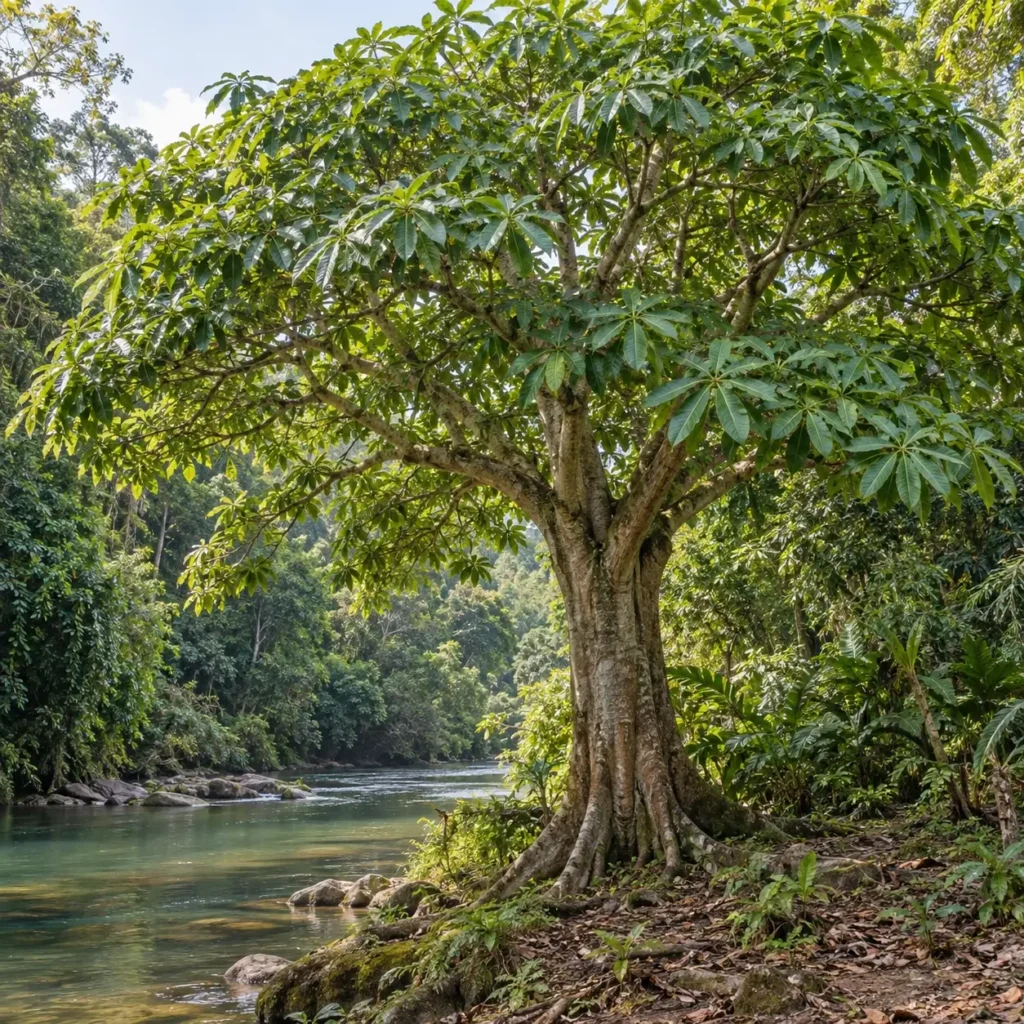
Pachira aquatica Comes from Tropical Wetlands
According to Kew’s Plants of the World Online, this accepted species belongs to the mallow family, Malvaceae, and is native from Mexico to southern tropical America. Its natural setting is the wet tropical biome, rather than the Asian homes and businesses where its lucky reputation is now familiar.
Forests beside rivers and streams are characteristic habitats. This waterside background helps explain why descriptions of the tree so often emphasize moisture. It also gives context to its appearance: a tropical forest tree has a very different life from a small ornamental specimen shaped for a windowsill.
For more botanical stories, visit Luckytata’s collection of tree articles.
Glossy Leaves Form a Spreading Green Canopy
The foliage of Pachira aquatica is palmately compound. Several leaflets radiate from a shared point, creating a shape that resembles an open hand. Five to seven leaflets are common, although a leaf can carry as many as nine. Their elongated outlines make the canopy feel both full and finely patterned.
Size varies with conditions. Singapore’s NParks species profile records trees reaching 23 meters in their natural habitat, with trunks that may develop buttresses. A small potted plant therefore represents only one stage and one cultivated expression of the species.
Fairchild also highlights its shiny leaves and swollen stem. Together, these features give young plants the appearance of miniature trees long before they approach their outdoor proportions.
Extraordinary Flowers Unfold After Dark
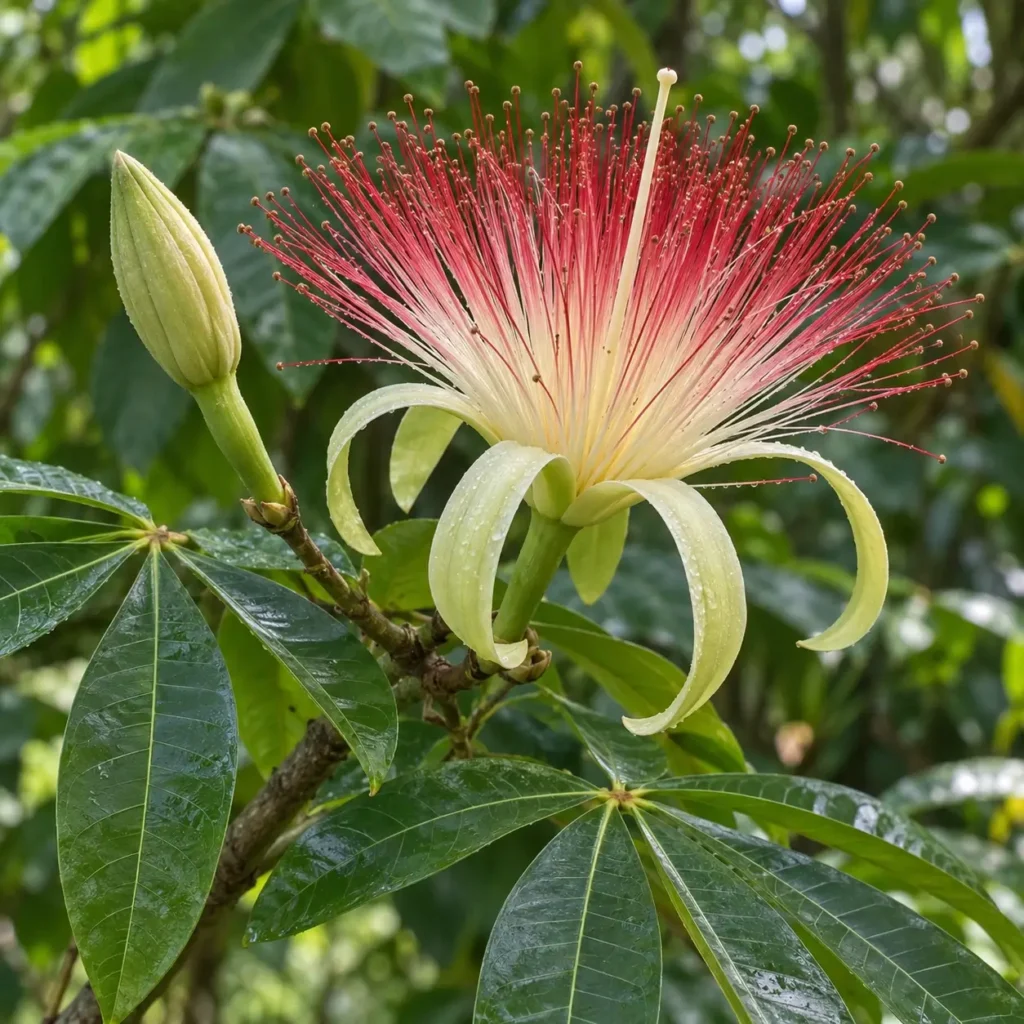
The flowers of Pachira aquatica are especially striking because their most dramatic feature is the mass of projecting stamens. Pale petals frame long filaments with reddish coloring, producing the impression of a loose brush or an airy plume.
A 2014 Amazonian floral study documented large, strongly scented flowers that opened at night. Opening was asynchronous, meaning the flowers did not all unfold together. The researchers also described a separation in the timing of male and female function, with the male phase occurring first.
These details make the flowering display more than a visual spectacle. Scent, timing, and floral structure are part of how the tree interacts with visitors. The study found relatively abundant, dilute nectar, with production increasing during the morning observation period. Night opening, therefore, does not mean that every aspect of floral activity ends at sunrise.
Bats and Moths Help Carry Pollen Between Trees
Pachira aquatica participates in a pollination network that includes both nocturnal and daytime visitors. Research from freshwater wetlands along Mexico’s Gulf coast identified bats and hawkmoths as the main night visitors, while honey bees were prominent during the day.
In this study of bats, moths, and honey bees, eight bat species carried the tree’s pollen. That finding describes the study population; it should not be treated as a fixed worldwide count of the tree’s pollinators.
The visitors also used different floral rewards. Bats and honey bees mainly collected or consumed pollen, while moths fed on nectar. Hand-pollination experiments indicated predominantly cross-pollinated reproduction, emphasizing the importance of pollen movement between trees.
For Pachira aquatica, the surrounding animal community is consequently part of its reproductive story. A flower’s beauty may catch our attention, but its relationship with those animals helps explain its form and timing.
Large Woody Fruits Contain Seeds with Traditional Uses
After successful reproduction, the tree develops substantial woody capsules. NParks describes fruits around 20 centimeters long, sometimes reaching 30 centimeters, which split into five sections at maturity.
Pachira aquatica seeds have documented culinary uses. Botanical accounts describe roasting, boiling, and grinding them, as well as cooking young leaves and flowers. These records show how communities have used the species, but traditional use alone does not establish that every preparation is safe.
NC State Extension’s plant profile specifically notes conflicting information about seed toxicity and the presence of cyclopropenoid fatty acids. This article therefore describes food traditions without recommending consumption. It also makes no claim that the seeds are suitable for pregnancy or that they provide a proven medicinal treatment.
A Familiar Money Tree Has a Botanical Lookalike
Common names can obscure an important distinction. Pachira aquatica and the related Pachira glabra are separate species, even though both appear in discussions of money trees and lucky plants.
Hong Kong’s government guide to the two species explains that they are frequently confused. It distinguishes the reddish stamen tips and brownish hairy fruits of the former from the white stamens and smoother green fruits of the latter.
This matters when reading plant descriptions online. A claim about one species should not automatically be transferred to the other simply because both are sold under familiar names. Flower and fruit characteristics provide more useful identification clues than a braided trunk, which reflects cultivation.
Why the Money Tree Represents Good Fortune
The lucky reputation of Pachira aquatica belongs to cultural tradition. NC State Extension describes its popularity in Taiwan during the 1980s and its association with prosperity in feng shui. The practice of braiding seedling stems also developed there, with the interwoven trunks understood as a way of retaining good fortune.
These meanings do not promise a financial outcome. They express hopes that people attach to a living plant: a flourishing home, a successful beginning, or a generous wish for someone else.
That symbolic relationship also offers a natural connection to Luckytata’s story, where trees inspire expressions of blessing. The connection is one of meaning and appreciation, rather than a claim that this species supplies the brand’s wood.
A Tree Worth Appreciating Beyond Its Lucky Name
Pachira aquatica brings together an unusual combination of qualities: tropical origins, distinctive foliage, dramatic night flowers, and relationships with animals that carry its pollen. Its cultural identity adds another layer, showing how a forest species can become part of everyday hopes and rituals.
Understanding both sides makes the money tree more interesting. It can be appreciated as a symbol of prosperity while also being recognized as a living species with its own habitat and reproductive biology. Behind the familiar braided plant stands a much larger story of flowers, forests, and human imagination.