Why the Coast Redwood Tree Grows Taller Than Any Other
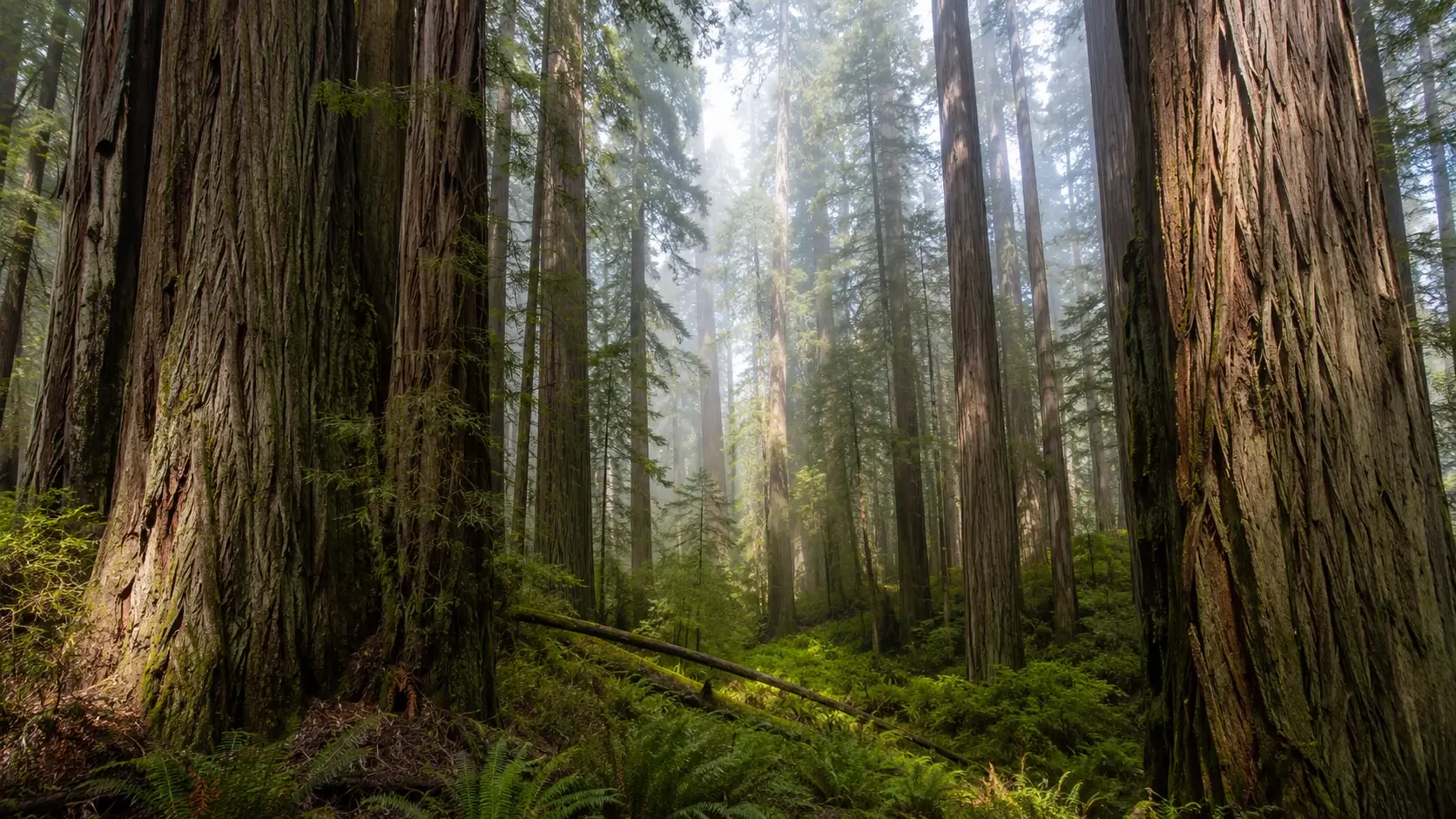
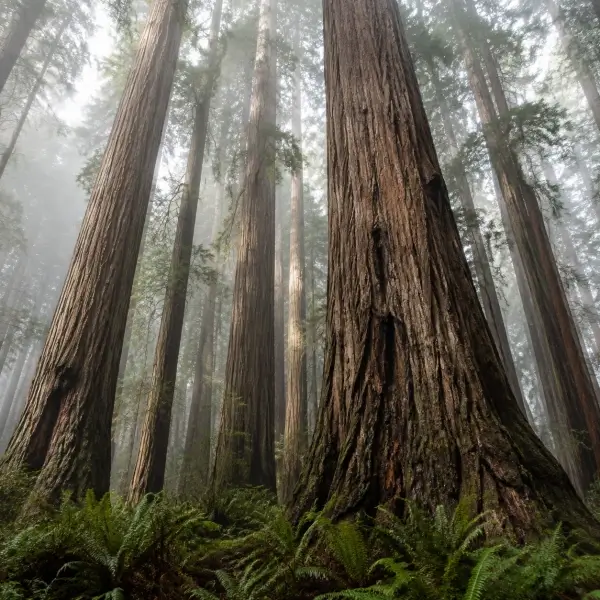
The coast redwood tree (Sequoia sempervirens) turns height into something almost architectural. Many mature redwoods exceed 60 meters, exceptional specimens rise beyond 100 meters, and Hyperion—the tallest known living tree—stands at roughly 116 meters. From the forest floor, the crown may be hidden by fog and layers of branches, leaving only the immense red-brown column of the trunk in view. To understand how these trees approach the biological limits of height, we must look at their coastal climate, their use of water, and the structures that let them recover after damage.
Coast Redwood Tree Facts at a Glance
| Category | Details |
|---|---|
| Scientific name | Sequoia sempervirens (D. Don) Endl. |
| Family | Cupressaceae |
| Common names | Coast redwood, California redwood, redwood |
| Native range | A narrow coastal belt from southwestern Oregon through western California |
| Typical habitat | Moist valleys, alluvial flats, stream terraces, and protected coastal slopes |
| Elevation | Sea level to about 915 meters, with most stands occurring lower |
| Height | Commonly over 60 meters; exceptional trees exceed 100 meters |
| Longevity | More than 2,200 years in documented cases |
| Bark | Soft, fibrous, red-brown, and up to about 30 centimeters thick |
| Reproduction | Seeds plus vigorous sprouting from root crowns, stumps, and basal burls |
The accepted scientific name and classification place the species in the cypress family, Cupressaceae. It is native only to a long, narrow band influenced by the Pacific Ocean. According to the U.S. Forest Service species profile, its natural range extends for roughly 724 kilometers but is generally only 8 to 56 kilometers wide. This limited distribution explains why the world’s tallest trees are tied so closely to one particular combination of moisture, mild temperatures, sheltered terrain, and summer fog.
The species is monoecious, carrying separate male and female cones on the same tree. Its small pollen cones release wind-borne pollen, while the ovoid seed cones mature from green toward brown and measure roughly two centimeters long. The evergreen leaves are spirally attached and vary in form and function according to their position, light exposure, and local climate.
A Giant Shaped by the Pacific Coast
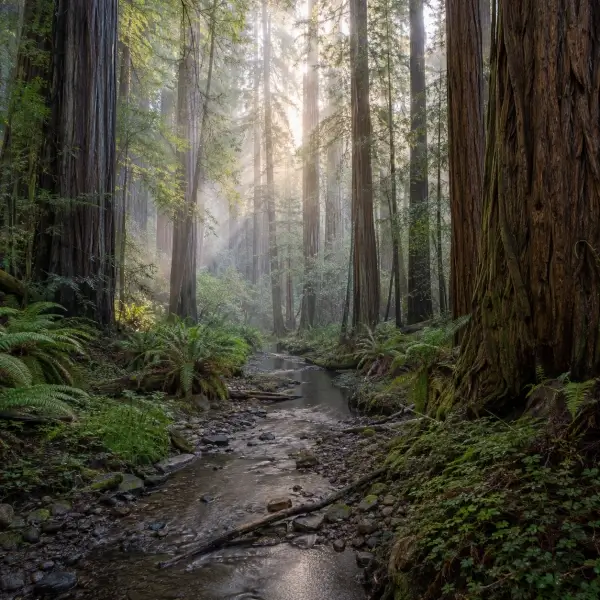
The tallest redwoods usually occupy deep, moist soils on alluvial flats, streamside benches, and protected valleys. Winters bring most of the annual rainfall, while summers are comparatively dry. The marine fog belt softens that seasonal contrast by cooling the forest, reducing water loss from leaves, wetting the canopy, and adding moisture to the soil.
Growth can be remarkably fast when light, water, and soil conditions align. Forest Service records note that established saplings may add around two meters in a favorable growing season. Over centuries, repeated growth produces a straight, buttressed trunk and a high crown. Large lateral roots spread widely, but the tree has no taproot. Compacted soil and repeated foot traffic can still injure this root system.
The outer surface of a mature coast redwood tree is equally distinctive. Its fibrous bark can reach about 30 centimeters in thickness. Combined with a high crown and the ability to resprout, it gives mature redwoods strong resilience to many fires. Severe fires can still wound the base, open pathways for decay, or kill the crown; survival depends on several defenses rather than on bark alone.
How a Coast Redwood Tree Drinks from Fog
Lifting water more than 100 meters is one of the greatest engineering problems faced by any plant. Water rises through microscopic conduits in the sapwood as evaporation from leaves creates tension within a continuous column of water. Cohesion holds water molecules together, while adhesion helps them interact with conduit walls. Gravity and resistance along the increasingly long pathway make the task harder with every additional meter.
Research on tall redwoods shows that hydraulic stress gradually limits leaf expansion and photosynthesis near the crown. A landmark study published in Nature estimated a maximum redwood height of approximately 122 to 130 meters if mechanical damage is excluded. That is lower than the 138-meter figure sometimes repeated in popular accounts, but it still places the tallest living redwoods remarkably close to a physiological ceiling.
Fog gives the tree a second route to hydration. During California’s dry summer, droplets collect on the crown. Some drip to the ground and enter the root zone, while some water is absorbed directly through leaves and stems. Forest research on foliar uptake identifies this as an efficient drought-relief mechanism because water reaching the canopy does not first have to make the entire journey upward from the soil.
Newer research from UC Davis has made this system even more fascinating. A redwood has two functionally distinct kinds of leaves. Peripheral leaves are more specialized for photosynthesis, while axial leaves absorb water far more effectively. Their positions shift with climate: in wetter northern forests, water-absorbing leaves tend to occur lower in the crown; in drier southern sites, more of them occur higher, where they can take advantage of limited fog and rain. A large tree may carry more than 100 million leaves, turning its crown into both a solar array and a vast atmospheric water collector.
Hyperion and the Search for the Tallest Living Tree
In August 2006, naturalists Chris Atkins and Michael Taylor encountered an extraordinary redwood in a remote part of Redwood National Park. A direct measurement reported by Save the Redwoods League placed it at 379.1 feet, or about 115.6 meters. They named it Hyperion after the Titan of Greek mythology.
Hyperion is an important symbol, but it should not be treated as a tourist monument. The National Park Service warns visitors not to seek it out: off-trail traffic has trampled vegetation and compacted soil around its root zone, and public access to the surrounding area is now closed.
The park also notes that the title of tallest tree is not permanent because redwoods may lose crown sections and later regrow them. For that reason, “approximately 116 meters” is more responsible than presenting one historical measurement as eternally exact.
The coast redwood tree probably cannot keep increasing in height forever. As the hydraulic pathway lengthens, leaves at the top receive less water, become smaller, and operate under greater stress. If the uppermost crown dries or breaks, a dead or damaged top may form. Fog helps postpone this limit, but it does not erase gravity. Hyperion’s real significance lies in how closely a living organism can approach that boundary while remaining active, responsive, and capable of repair.
Burls and a Remarkable Capacity for Renewal
Large, knotty growths often appear around the base or trunk of a redwood. These basal burls contain dormant buds that can produce new shoots when the main trunk is cut, toppled, or damaged by fire. Redwoods also sprout from root crowns and stumps, sometimes forming a ring of new trunks around the parent base.
This ability makes the species unusual among conifers. Seed reproduction still matters, but seed viability and germination can be low. Vegetative sprouting allows an established root system to support rapid new growth after disturbance. A visible burl is therefore more than a curious lump of wood; it is part of a biological reserve system that stores the possibility of renewal.
Cutting a burl wounds a living tree, and illegal burl poaching has damaged protected redwoods. In a natural forest, these structures are living tissues connected to the survival of the parent and the future structure of the grove.
From Valuable Timber to a Forest in Need of Repair
Redwood lumber became highly valued because it is easy to work and naturally resistant to decay. It was used for building materials, shingles, posts, and railroad ties. During the nineteenth and twentieth centuries, intense logging supplied expanding California communities and transport networks. California State Parks records that by 1884, 28 mills in the Santa Cruz area were processing more than 34 million board feet each year.
The cost was immense. The National Park Service states that only about 5 percent of the original old-growth redwood forest remains. Logging did more than remove individual giants. Roads altered slopes and streams, dense stands of young trees replaced complex old forest, and isolated remnants lost parts of the ecological network that had developed over centuries.
Modern restoration is not an attempt to manufacture instant old growth. Redwoods Rising removes failing logging roads, repairs streams, and selectively thins overcrowded second-growth stands so remaining redwoods have more light and room. The partnership has a long-term goal of rehabilitating more than 70,000 acres within Redwood National and State Parks.
A restored young forest will still need centuries to acquire the massive trunks, cavities, layered canopies, fallen wood, and rich habitat of an ancient grove.
Why the Tallest Forests Still Matter
A coast redwood tree is not simply a record holder. Its crown supports plants and animals high above the ground; its roots and fallen wood participate in nutrient cycles; its trunk stores carbon for centuries; and its canopy reshapes how water moves through the forest. The tree’s height is the visible outcome of an entire system—Pacific fog, wet soil, protective bark, specialized leaves, regenerative buds, and long periods without catastrophic interruption.
Standing beneath one also changes the scale of human attention. A seed can become a column taller than a 30-story building, survive fires and storms, and begin new trunks from dormant buds. Yet logging and concentrated foot traffic can damage what took centuries to form.
The future of the coast redwood tree therefore depends on more than admiring Hyperion. It depends on protecting intact old-growth groves, respecting trail closures, restoring damaged watersheds, and allowing young forests enough time and space to become complex again. The tallest trees on Earth show how far life can rise, but their deeper lesson is that true height is built slowly—and preserved through restraint.