America’s Tree of Hell
To many readers, the tree of heaven sounds like a sacred plant. In reality, Ailanthus altissima is a fast-growing deciduous tree from China with a story that moves between philosophy, horticultural fashion, urban survival, biological invasion, and agricultural crisis. In China, it was never just an anonymous roadside tree. In the United States, it was first admired as an exotic shade tree, then gradually recast as an invasive species that land managers struggle to control today.
An Old Chinese Tree with an Unusual Reputation
Long before Ailanthus altissima became a problem in American cities and forests, it had already entered Chinese cultural memory. In the Zhuangzi, Huizi complains about a large “ailanthus” tree whose trunk is swollen and whose branches are crooked, making it useless to carpenters. Zhuangzi answers from a different angle: if the tree is useless for timber, then it can escape the axe and offer shade in a free and open place.
That old debate gives the species a surprisingly modern frame. The tree was seen as big, vigorous, awkward, and not especially valuable as wood. Yet those same traits also made it hard to ignore. It grew quickly, threw broad shade, tolerated rough sites, and survived where more delicate trees might fail. The “useless tree” was not powerless; it simply did not fit the human idea of usefulness.
This is the first lesson of Ailanthus altissima. Its value changes depending on where people plant it, what they expect from it, and what ecological limits surround it. In China, it lived among familiar insects, diseases, competing plants, and cultural meanings. In America, many of those checks were missing.
How to Recognize Ailanthus altissima
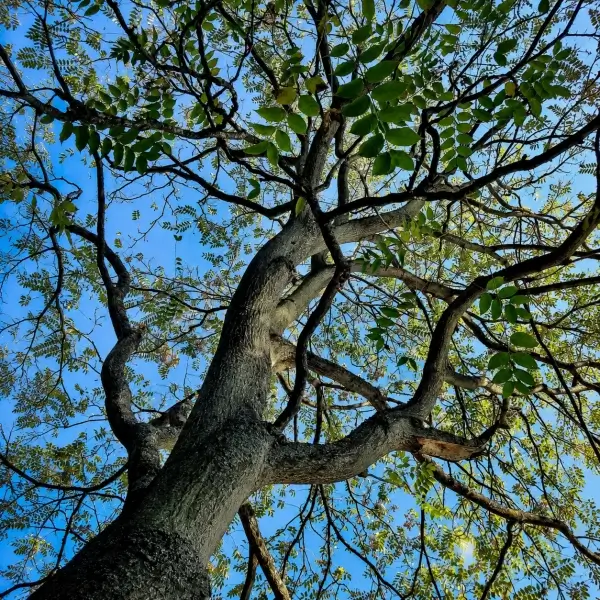
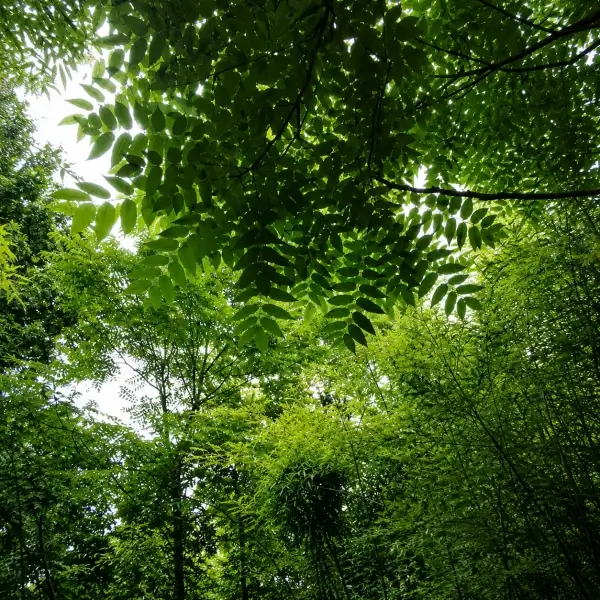
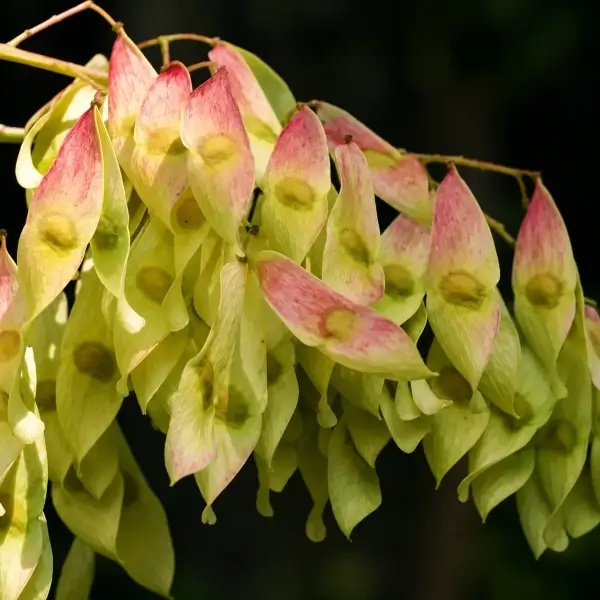
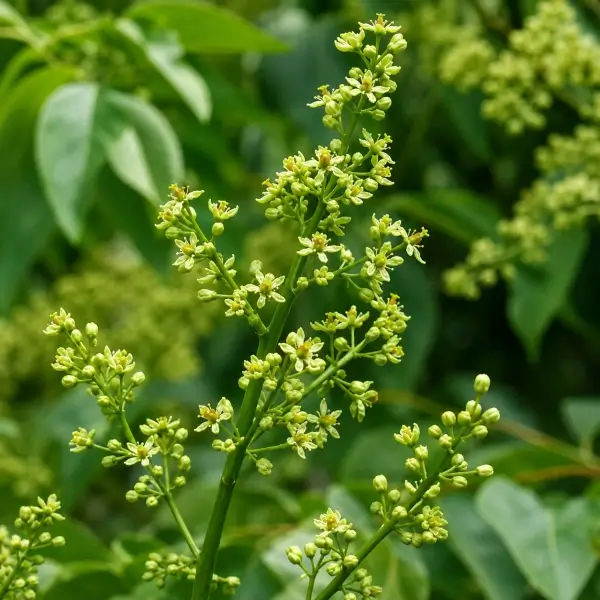
For readers trying to connect the story with a real tree, the identification details are practical. Ailanthus altissima often has very large compound leaves, smooth-edged leaflets with small glandular teeth near the base, and clusters of twisted winged seeds that can remain visible into colder months. When leaves, twigs, or male flowers are crushed, the smell is often described as unpleasant, which explains why many people notice the tree before they know its name.
Its bark can become pale gray and patterned with a texture sometimes compared to cantaloupe skin. Young shoots grow quickly, and multiple stems may appear around an older trunk because the root system keeps sending up suckers. These clues matter because Ailanthus is often confused with native sumacs or young walnut trees. Correct identification is important before anyone attempts removal, since casual cutting can encourage more sprouts instead of solving the problem.
How the Tree of Heaven Reached the West
The tree’s journey west began through eighteenth-century botanical exchange. French Jesuit Pierre d’Incarville sent seeds from China to Europe in the 1700s. The tree later moved through European botanical collections and reached the United States in 1784, when it was introduced in Philadelphia. A second American introduction followed in New York around 1820, and by the 1840s it was appearing in nurseries as an ornamental tree.
At first, American gardeners had good reasons to like it. The tree of heaven looked dramatic, almost tropical, with long compound leaves and large seed clusters. It grew fast, tolerated pollution, endured poor soils, and could establish in urban spaces where many native trees struggled. For a young country building streets, gardens, and industrial cities, this seemed like a useful gift from the other side of the world.
Its name helped too. “Tree of heaven” suggested height, vitality, and aspiration. The tree could rise quickly above hot streets and create shade where shade was badly needed. In that early period, few people were thinking about invasive ecology. They saw an ornamental survivor, not a future management problem.
Why a Useful City Tree Became an Invader
The qualities that made Ailanthus altissima attractive in the nineteenth century later became the reasons people feared it. It can produce huge numbers of wind-dispersed seeds, and mature female trees are reported to produce more than 300,000 seeds in a year. It also spreads without seeds, sending up new shoots from roots and stumps. Cutting it down without proper control can make the problem worse by triggering dense regrowth.
Ailanthus altissima is also allelopathic, meaning it can release chemicals from leaves, roots, or bark that limit the growth of nearby plants. In disturbed places such as roadsides, vacant lots, rail corridors, woodland edges, and construction sites, this gives it a strong advantage. It does not need perfect soil. It does not need careful care. It is built for opportunity.
That is why the same tree can feel so different in China and the United States. In its native range, it is part of a wider ecological network. In the United States, it often behaves like a pioneer species with few local restraints. It grows in gaps, along infrastructure, and across neglected land, then forms thickets that crowd out native vegetation.
The nickname “tree of hell” did not come from one flaw. It came from the combination of smell, speed, seed production, root suckering, chemical competition, and difficulty of removal. A tree once praised for resilience became a symbol of what can happen when a hardy species is moved into a new ecological context.
The Spotted Lanternfly Changed the Story Again
For many years, the tree of heaven was already unpopular among ecologists, gardeners, and land managers. Then another species arrived and made the story more serious. In 2014, the spotted lanternfly, Lycorma delicatula, was confirmed for the first time in the United States in Berks County, Pennsylvania. Specimens were collected from Ailanthus bark, and the insect was also found feeding on wild grapevine.
This mattered because the spotted lanternfly strongly favors the tree of heaven as a host. The insect feeds on plant sap and excretes sticky honeydew, which encourages sooty mold and can make trees, cars, patios, and sidewalks dirty and unpleasant. More importantly, it also feeds on economically important plants, especially grapes.
The result is a strange partnership between two invaders. The tree provides food and breeding habitat for the insect, while the insect increases public attention toward the tree. A plant that had already spread through cities and disturbed landscapes became part of a larger agricultural problem. Pennsylvania officials and researchers have warned that uncontrolled spotted lanternfly damage could cost the state hundreds of millions of dollars annually and affect thousands of jobs.
This is why many control programs now treat the tree of heaven not only as an invasive plant, but also as part of spotted lanternfly management. In some places, female trees and most young growth are removed, while selected male trees may be used as “trap trees” after treatment. The goal is not simply to cut down every trunk, but to understand how the plant and insect interact.
What the Tree Teaches Us About Invasive Species
The story is tempting to tell as a fall from paradise to disaster, but the truth is more nuanced. The tree of heaven did not change its nature when it crossed the ocean. It remained fast-growing, tough, smelly, fertile, and persistent. What changed was the surrounding system.
In China, its traits existed inside a long relationship among local climate, insects, fungi, competing plants, and human culture. In America, those same traits were first admired because they solved urban problems, then condemned because they created ecological ones. The lesson is not that one country’s plant is “bad” and another country’s landscape is “good.” The lesson is that movement matters. A species can be ordinary in one place and disruptive in another.
That is also why control requires patience. Ailanthus altissima cannot usually be managed by a simple cut. Its roots store energy, its seeds travel, and its sprouts return. Effective management depends on accurate identification, timing, repeated follow-up, and local guidance.
Conclusion
The tree of heaven began its American life as a symbol of exotic beauty and practical shade. Over time, its biological strengths became ecological problems, and the arrival of the spotted lanternfly turned an already troublesome tree into a public agricultural concern. Its Chinese philosophical image as the great “useless tree” now feels strangely prophetic. Useless for timber, useful for shade, dangerous as an invader, and valuable as a warning, the tree refuses to fit one simple label.
Perhaps that is the real story of the tree of heaven. It is neither purely heavenly nor purely hellish. It is a powerful plant in the wrong place, a reminder that nature is never separate from context, and that every introduction carries consequences long after the first seed takes root.