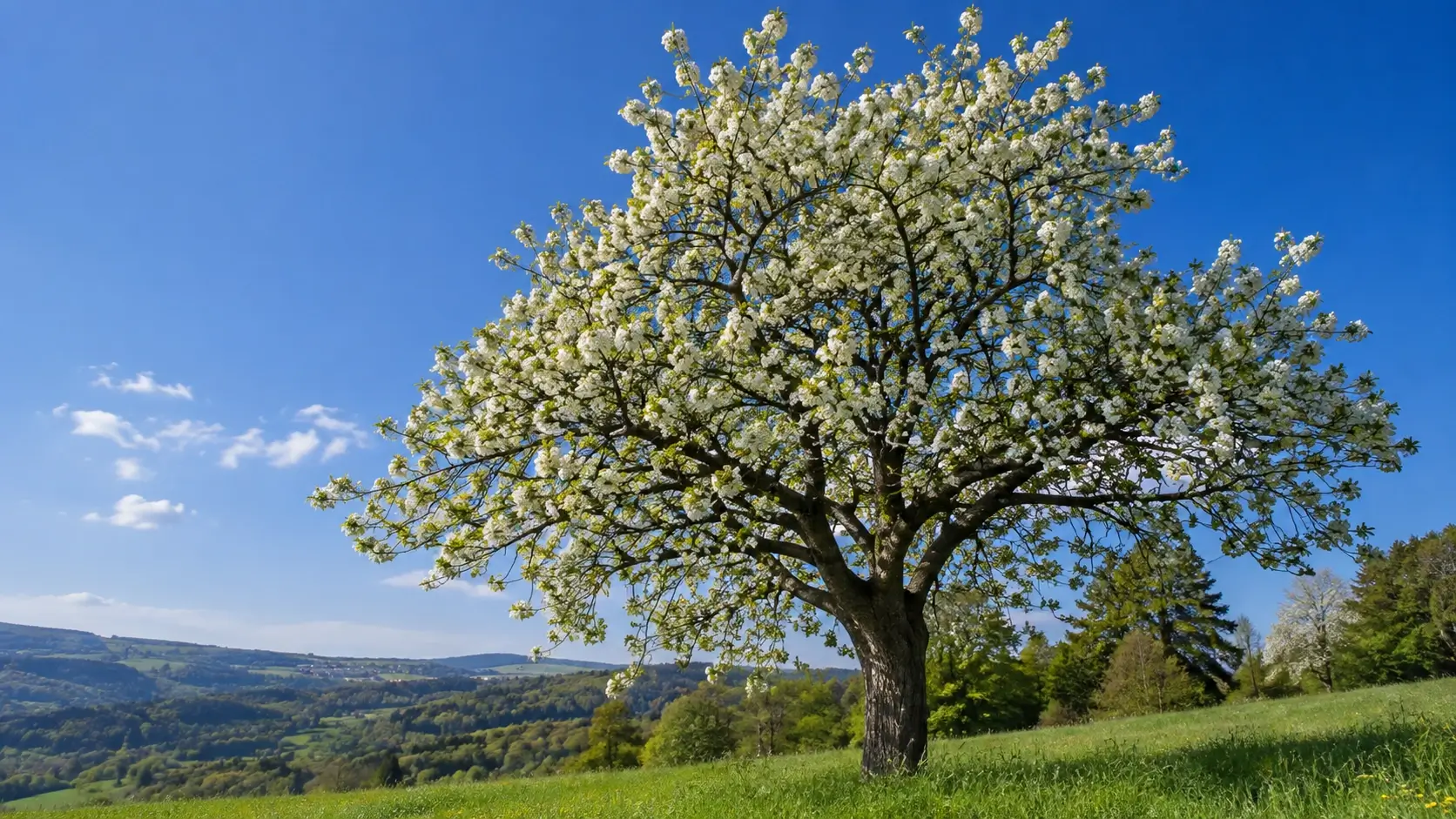
The Miraculous Biology of Trees
When you look at a tree, you are looking at a living illusion. The vast majority of a tree’s bulk is already dead. In fact, the only truly alive portion is a paper-thin layer of cells sandwiched between a dead wooden skeleton and a protective outer shell. Yet, trees are some of the most extreme organisms on Earth. Driven by a unique tree evolutionary history, they possess a near-miraculous survival strategy: they build their massive bodies out of thin air, weaponize root acids to crush solid rock, and maintain a massive internal negative pressure that would instantly tear a human apart.
But how exactly do they achieve this? To understand the mechanisms of tree growth and how vascular plants conquered our planet, we must rewind time to the very beginning—to an ancient, cutthroat competition for the sky.
The Ancient Race for the Sky
For the first billion years, the ancestors of modern plants thrived exclusively in sun-drenched oceans. Their bodies were thin, soft, and completely reliant on surface absorption for water. Through primitive photosynthesis, they converted sunlight, carbon dioxide, and water into energy—specifically, sugars.
However, approximately 470 million years ago, these pioneering organisms made a fateful leap to conquer a harsh, hostile, and unknown frontier: dry land.
Initially, these land plants resembled green carpets, clinging tightly to damp terrain. But unlike the ocean, the soil offered no room for drifting. A fierce competition emerged in a completely new dimension: vertical height. The taller a plant grew, the more sunlight it intercepted, effectively starving its shorter rivals beneath. Height became a lethal evolutionary weapon, and the battle for the canopy officially began.

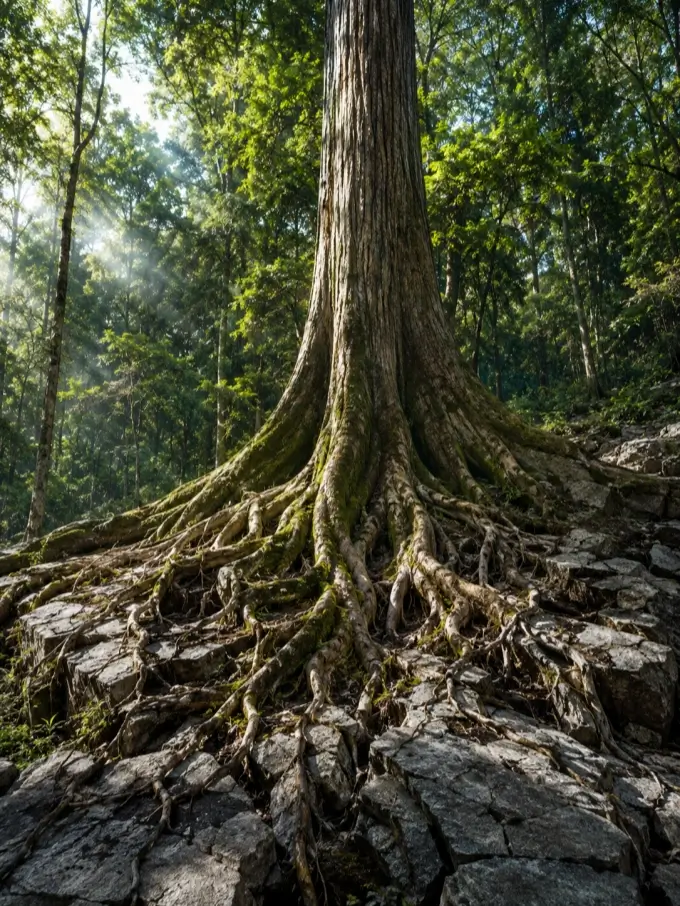
Lignin: The Evolutionary Breakthrough in Plant Cell Walls
Before this vertical arms race, plants relied primarily on cellulose to structure their bodies. While cellulose provided basic shape, it lacked the structural integrity required to defy gravity. Following tens of millions of years of evolutionary trial and error, a revolutionary breakthrough occurred within the plant cell wall matrix: the emergence of lignin.
Lignin is a complex polymer composed of countless interconnected aromatic rings. It is incredibly rigid, flexible, highly waterproof, and exceptionally resistant to decay—essentially acting as the reinforced concrete of the plant world. By filling the microscopic gaps between cellulose strands, lignin solidified the plant’s architecture.
Armed with this new structural strength, plants gained the leverage to push upward, claim the sunlight, and rapidly expand their territorial footprint.
The Birth of the First Trees
Several million years later, certain plant lineages doubled down on this strategy, investing heavily in heavy lignin production. Approximately 385 million years ago, they perfected this biological “reinforced concrete,” giving rise to the very first trees.
In a geological blink of an eye, these organisms became the giants of the Earth, shooting up over 20 meters into the air. However, this massive scale introduced a critical engineering crisis:
- How could water be transported from deep underground up to the photosynthetic canopy?
- How could the sugars manufactured in the leaves travel back down to sustain the roots?
For a single cell, bridging a gap of dozens of meters is the logistical equivalent of living in London, commuting to Egypt for lunch, and traveling to New York just to grab a drink. To survive, trees evolved a mind-boggling circulatory system that unintentionally granted them the potential for near-immortality.
The Dead Conveyor Belt: Understanding Xylem Function
If you take a cross-section of an ancient trunk, you will find the biological command center: the vascular cambium. This is an incredibly thin ring of active stem cells, only a few cell layers wide and virtually invisible to the naked eye. These stem cells divide in two directions—inward and outward—creating two highly specialized teams.
The cells migrating inward embark on a literal conveyor belt to death, forming the xylem morphology:
- Expansion: With each cell division, the cambium pushes outward, causing the tree to grow thicker.
- Lignification: As these internal xylem cells mature, they trigger massive lignin production, hardening themselves into rigid conduits.
- Apoptosis (Programmed Cell Death): Finally, they hollow themselves out, discarding all the cellular machinery that kept them alive.
What remains is a network of rigid, hollow tubes. Year after year, new rings of dead cells enclose the old ones, creating what we know as tree rings. Wood, in its truest sense, is a massive graveyard of trillions of microscopic cellular skeletons.
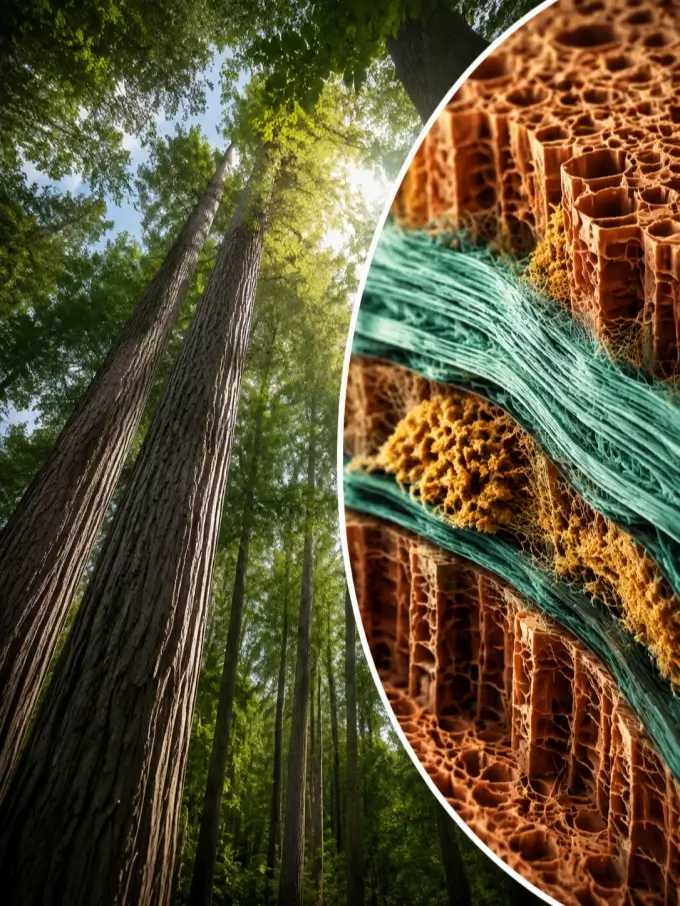

The Physics of Transpiration and Sap Ascent
This network of hollow pipelines leverages the unique chemical properties of water to achieve highly efficient xylem sap transport through transpiration pull.
Water molecules behave like tiny, sticky magnets due to hydrogen bonding. They naturally cling together, meaning that when one molecule moves, it pulls its neighbor along, forming an unbroken molecular chain. In a tree, this chain stretches all the way from the deep roots to the highest leaves.
At the canopy, solar heat causes water to evaporate through millions of microscopic pores (stomata). This process, known as transpiration, accounts for 95% of the tree’s water loss. The evaporation exerts a massive upward tensile force, pulling the entire water column up from the roots.
This negative pressure is astonishingly powerful, capable of lifting water over 100 meters against gravity. Generating this pull requires an internal suction of dozens of atmospheres—equivalent to the crushing pressures found hundreds of meters deep in the ocean. Human engineering pales by comparison; our best suction pumps struggle to lift water past 10 meters because the extreme negative pressure causes water to boil at room temperature. However, because a tree’s xylem conduits are incredibly narrow and completely airtight, the water remains stable in its liquid state all the way to the top.
The Living Pipeline: Phloem Structure and Function
Water, however, is only half the story. The sugars produced via photosynthesis must travel downward to nourish the underground root systems. Furthermore, cells from the roots to the leaves must coordinate their growth and signal injuries. This vital communication is handled by the cells growing outward from the cambium: the phloem.
As phloem cells migrate outward, they differentiate into three distinct, highly coordinated roles:
- Sieve Tube Elements: These cells form the physical transport pipeline. Upon maturity, they undergo partial self-destruction, digesting their own organelles and even their nuclei. Fully hollowed out and connected end-to-end, they become mechanical pipelines. Lacking the means to sustain themselves, they rely entirely on a secondary cell line to survive.
- Companion Cells: Linked to the sieve tubes via microscopic channels (plasmodesmata), companion cells act as life-support systems. They manage the metabolism of the sieve tubes, provide metabolic energy, deliver genetic instructions, and perform vital cellular repairs. Together, these two cell types form a hyper-thin, living web of nutrient pipelines and signal cables.
- Parenchyma Cells: The unsung laborers of the tree. Some act as storage vaults, hoarding starches, sugars, and water to help the tree survive harsh winters. Others function as microscopic medics to heal physical trauma, while some actively synthesize chemical toxins and antifungal countermeasures to neutralize invading pathogens.
The Protective Armor: Periderm and Bark Formation
Just outside the active phloem lies another layer of lateral meristem cells generating a second outward-bound conveyor belt. These specialized cells mature, accumulate waterproof suberin, and—much like the internal xylem—undergo programmed cell death to form a rugged protective barrier: the outer bark (periderm).
Like human skin, the bark seals the tree, safeguarding the hyper-thin layer of living tissue beneath from parasites, physical damage, and environmental stress.
The Ultimate Biological Design
Ultimately, what is a tree? The truly living part of a trunk is an incredibly fragile layer, barely a few millimeters thick. It is built entirely upon a mountain of dead cellular skeletons and encased in a armor of departed cells. The vast majority of a tree’s biomass is completely dead.
This is why damaging a tree’s bark is so catastrophic. While it may appear to be a superficial scratch, peeling it away severs the tree’s vital lifelines, effectively killing the organism.
Yet, as long as a tree avoids severe drought, disease, structural storms, or human logging, this unique architecture grants it the potential for biological immortality. Because their meristematic cells do not undergo typical aging, trees can theoretically grow indefinitely. Today, we still share the planet with ancient bristlecone pines that were already fully grown 5,000 years ago, back when humans were constructing the very first Egyptian pyramids.
“Tree” is not a strict monophyletic classification in biology; rather, it is an incredibly successful evolutionary strategy. Countless distinct plant lineages have independently evolved into tree forms. They conquered the sky, bypassed the physical limitations of height, and became the dominant features of our planet. Today, over three trillion trees cast their magnificent shadows across the globe—with root systems mining the earth with acids and tool-wielding canopies building empires out of thin air.