How Do Trees Grow? The Secret Science of Eating Air and Underground Fungi Networks
Think trees grow by eating soil? You are completely wrong. A tree’s primary food source is actually air. Even more mind-blowing, these incredible organisms secretly act as rock-breaking engineers and run massive underground trading networks with fungi. It sounds bizarre, but it is entirely true. Let’s break down the fascinating science behind how trees really survive and thrive.
The "Eating Air" Mechanism: Building Mass from Carbon Dioxide
First, we need to clear up a massive misconception: over 90% of a tree’s growth comes from “eating” air. Carbon is the core biological building block for all life. Whether building new cells, expanding branches, or growing a trunk, a tree relies entirely on carbon. Its primary source? Atmospheric carbon dioxide (CO2).
This is no easy feat. CO2 makes up only about 0.04% of our atmosphere—that is a mere 425 out of every 1 million air molecules. To absorb just 1 ton of carbon, a tree must filter a staggering 6,000 tons of air (equivalent to 5 million cubic meters). To handle this massive workload, trees have evolved into ultra-precise biological industrial cities.
Inside the Leaf Factory: Photosynthesis and the Water Cycle
To process all this air, the tree operates like a highly organized corporation:
The Canopy: The central command headquarters.
The Branches: The logistical transport routes.
The Leaves: Millions of core processing factories.
A single leaf is incredibly thin—often only 10 cells thick, which is far thinner than our own skin. The transparent upper epidermis lets light in while locking in moisture. Beneath it lies the spongy, chloroplast-filled cell layer where the actual “factory workers” operate, allowing gases to flow freely. The leaf veins act as highways, transporting water and sugars.
At the bottom of the leaf are thousands of microscopic “mouths” called stomata, controlled by two lip-like guard cells. A mature tree pumps dozens of liters of water into its leaves daily. Interestingly, 95% of this water evaporates through the stomata. This not only cools the tree but humidifies the surrounding air. When billions of trees do this together, their water vapor creates clouds and rain. The Amazon Rainforest exists largely because of this very mechanism!
The remaining 5% of water triggers the core magic of photosynthesis: using sunlight to split water into hydrogen and oxygen. The oxygen is released, while the hydrogen combines with CO2 to synthesize glucose—the tree’s ultimate energy battery and building material. Every animal that eats plants (or eats animals that eat plants) is essentially just borrowing the carbon that trees manufactured.
The Oxygen Myth: Do Trees Really Produce Most of Earth's Oxygen?
Here is a surprising cold fact: trees breathe just like we do. While they produce oxygen via photosynthesis during the day, the leaf factories shut down at night. In the dark, trees absorb oxygen through their stomata, bark crevices, and root tips to break down glucose for energy. The leftover oxygen they produce is often consumed by soil microbes.
In reality, the vast majority of Earth’s free oxygen is produced by marine algae and cyanobacteria. Trees are vital, but they are technically auxiliary players in the global oxygen supply.
The Underground Root Kingdom: Rock-Breaking Hydraulic Engineers
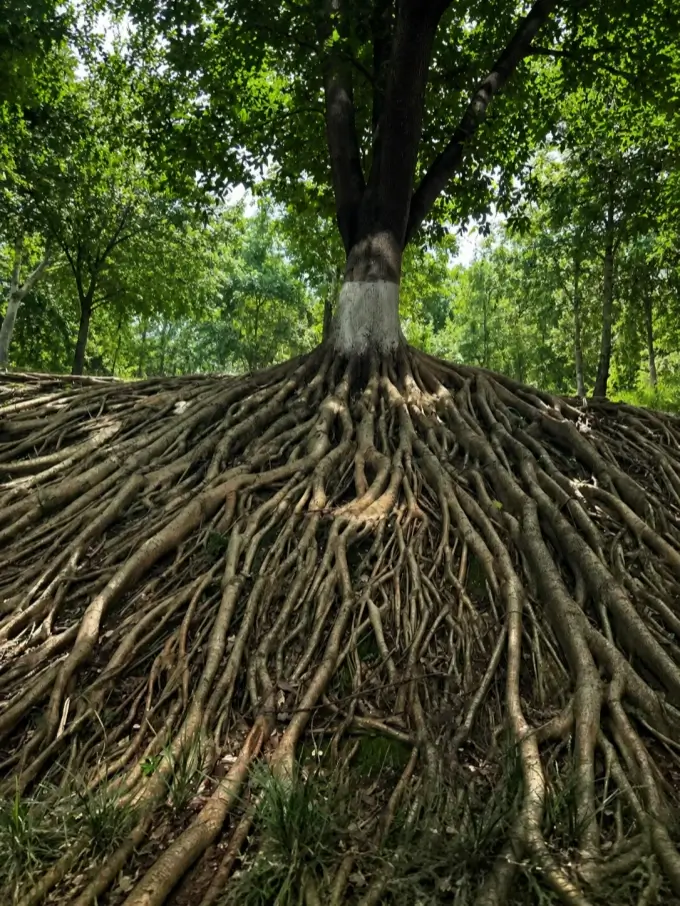
While the canopy is amazing, the tree’s underground kingdom is even crazier. A tree’s root system is rarely a perfect mirror of its canopy. In fact, 50% of the roots are concentrated in the top 25 cm (10 inches) of soil, tangling with neighboring roots into a massive net.
Roots only plunge deep during extreme droughts, sometimes reaching depths equivalent to a 20-story building. However, most remain shallow. Why? Because roots are not just for anchoring the tree—they are actively hunting for nutrients. Carbon and water alone are not enough to build DNA and proteins.
To navigate the dark underground, root tips are equipped with “cheat codes”:
- Gravity-Sensing Cells: Ensuring they always know which way is down.
- Environmental Sensors: Detecting moisture, temperature, and even the acoustic vibrations of flowing water.
When roots hit solid rock, they transform into miners. Acting like hydraulic jacks, the roots absorb water, swell, and physically crack the hard stone. They then release a cocktail of organic acids to dissolve the rock, using special molecules to extract the trapped minerals. These soft, fleshy roots are literally rock-chiseling engineers.
The Wood Wide Web: The Symbiotic Trade Alliance with Fungi
Despite their formidable skills, trees still need allies. Enter mycorrhizal fungi.
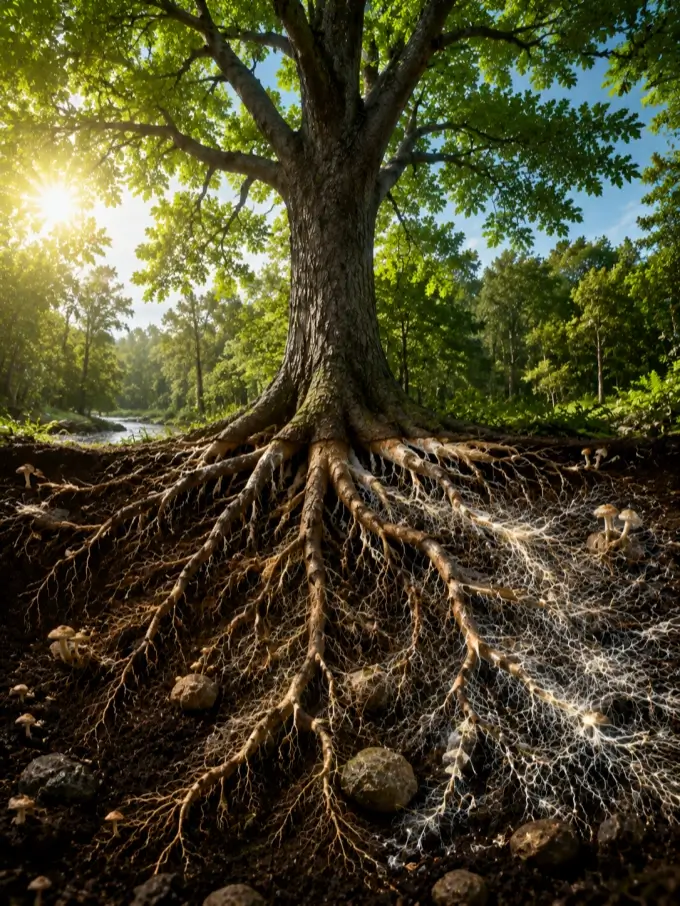
Fungal threads (mycelium) are microscopic—fine enough to penetrate soil crevices that thick tree roots cannot reach. They act as an extension of the tree, scavenging distant water and minerals. In exchange, the tree pays the fungi with the sugary glucose produced by photosynthesis.
This is an evolutionary trade alliance hundreds of millions of years in the making:
- Some fungi drill directly into the tree’s root cells to establish “trading posts.”
- Others wrap around the root tips, acting as bodyguards to fend off hostile microbes.
- The Network Effect: In a single cubic meter of forest soil, there may be a few kilometers of tree roots, but there are hundreds of kilometers of fungal mycelium.
This fungal network connects entire forests together. Trees use the Wood Wide Web to communicate, share nutrients, and even warn each other of danger. It is widely considered one of the most complex biological structures on Earth.
Conclusion: The Quiet Giants of the Ecosystem
We often think of trees as quiet, static, and simple. In reality, they “eat” the air, shatter solid rocks, trade with fungi, and communicate with their neighbors. The 2,800-ton General Sherman tree has stood tall for millennia relying on this exact, miraculous system.
We are still uncovering the secrets of trees. Their underground relationships and microbial interactions hold countless mysteries waiting to be explored. These silently growing giants are not just the largest organisms on Earth—they are the very foundation of our entire ecosystem.