How European Aspen Turns Wind Into a Forest Advantage
Imagine a solar panel that could tilt whenever the wind changed, receiving light from constantly shifting angles. The European aspen (Populus tremula) creates a similar impression. Its leaves flicker and rustle in even a gentle breeze, turning the crown into a moving mosaic of green and silver. This motion changes how sunlight passes through the canopy and may also influence leaf temperature and gas exchange. A two-sided solar panel is therefore a useful metaphor, although the biology is more complex than simply “collecting extra sunlight.”
Why European Aspen Leaves Tremble
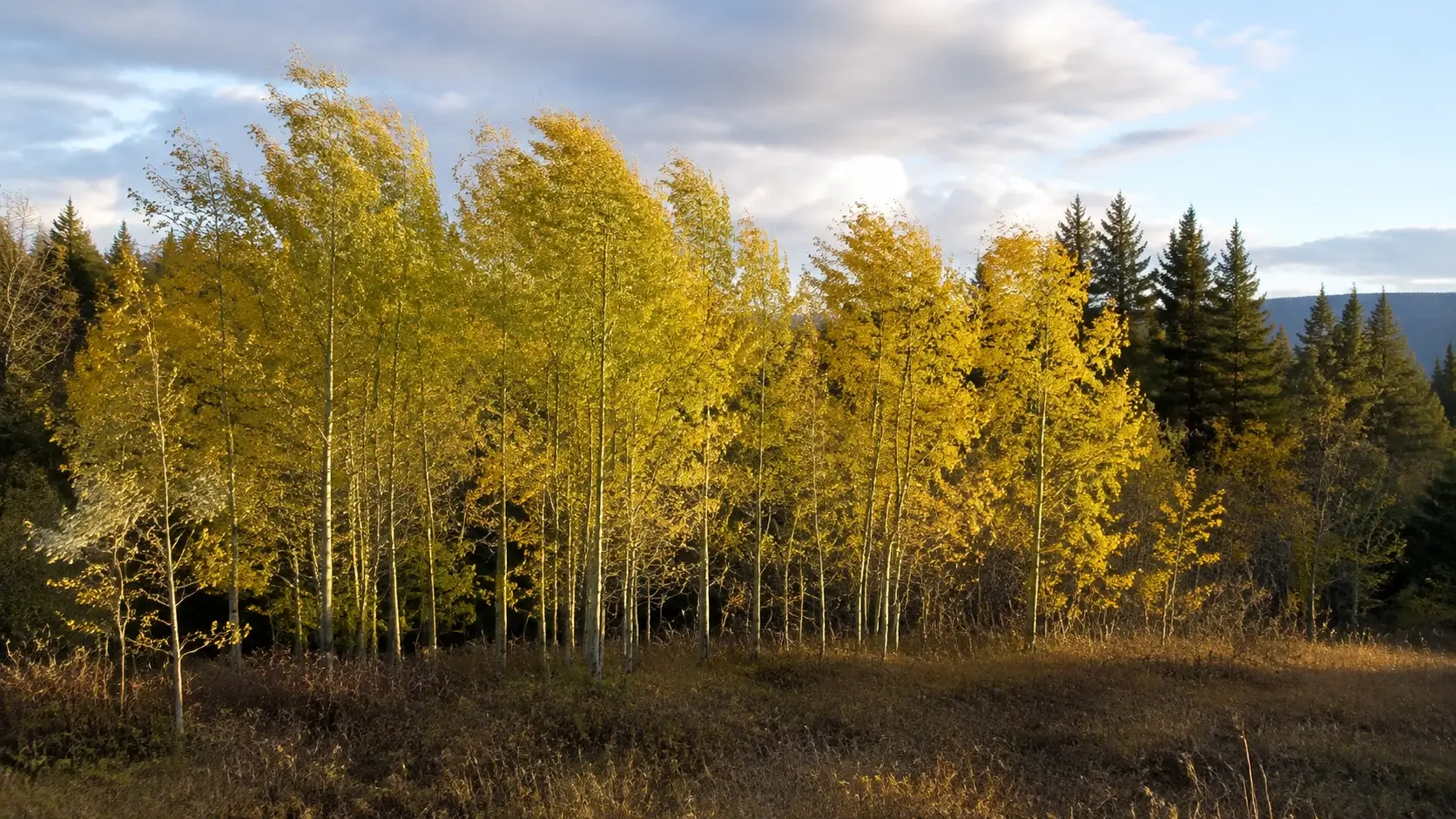
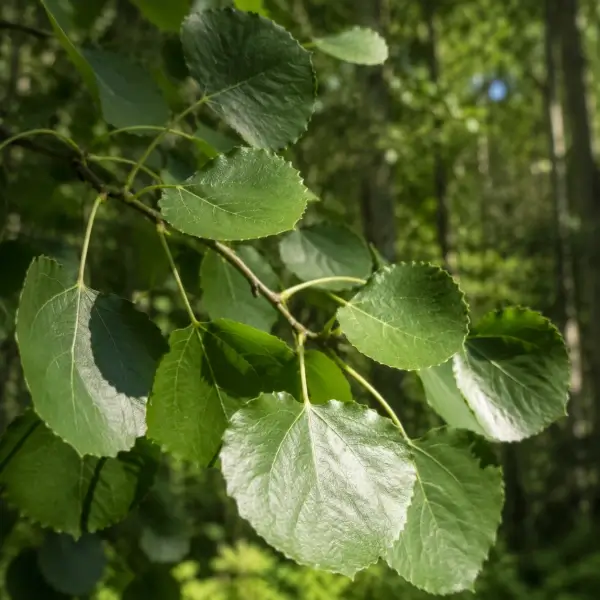
The secret lies not in the leaf blade but in the petiole, the small stalk joining the leaf to the twig. On mature branches, the nearly round leaves are carried on long, flexible petioles that are flattened from side to side. Because the stalk bends and twists easily, a light breeze is enough to make the blade oscillate. This is why the tree is called trembling or quaking aspen and why its scientific name, tremula, refers to trembling.
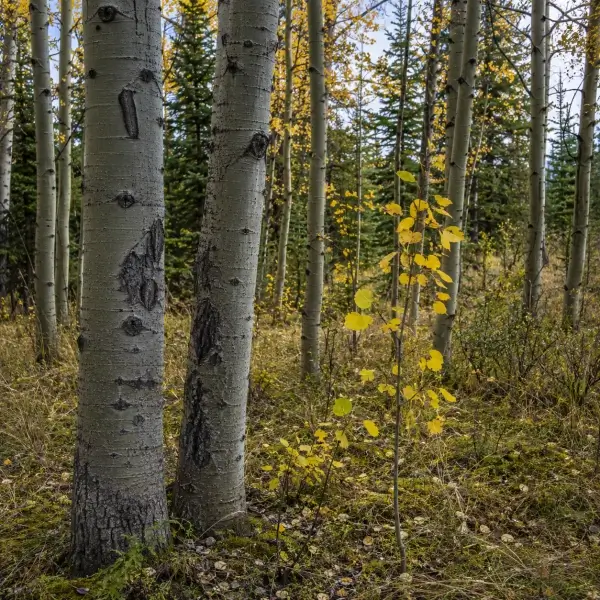
Young foliage often begins coppery, becomes green in summer, and turns brilliant yellow or occasionally red in autumn. Leaves on seedlings and vigorous root shoots can be heart-shaped or triangular, much larger than mature crown leaves, and attached by less-flattened petioles.
Research on poplars and the closely related North American quaking aspen shows that flutter can create shorter, more frequent sunflecks and distribute light more evenly through the canopy. Modeling also suggests that changing leaf angles can make light interception more uniform. This does not prove that every movement increases photosynthesis, but it shows why the crown behaves like a dynamic light-management system rather than a set of fixed panels.
A Pioneer Tree Built for Rapid Growth
European aspen is a light-demanding pioneer species. Instead of waiting patiently beneath a closed canopy, it performs best where disturbance has opened the sky. Fire, storms, flooding, clearing, or abandoned land can create the bright spaces it needs. Once established, young trees grow quickly, especially when moisture is available and the soil remains well aerated.
This member of the willow family, Salicaceae, can grow on rocky ground, loamy sand, or heavy clay, although stagnant, oxygen-poor soil is less suitable. Its native range stretches through cool temperate and boreal Eurasia, north of the Arctic Circle and south into mountains and parts of North Africa. In favorable conditions, a tree may reach about 40 meters, exceed one meter in trunk diameter, and live for up to roughly 200 years. Young bark is smooth and pale grey-green; older bark becomes darker and fissured.
Fast early growth helps the species claim an opening before slower competitors close the gap. Growth is especially vigorous during the first two decades, after which competition gradually reduces the pace.
One Crown Above Ground and a Network Below
European aspen reproduces sexually, but its most dramatic expansion often happens underground. Male and female catkins grow on separate trees before the leaves appear. Wind carries the pollen, and female catkins later release tiny, cottony seeds. The seeds travel widely, but germination requires a moist, open seedbed.
Root suckering offers a faster route. Shallow lateral roots send up shoots, especially after the parent trunk is damaged by cutting, fire, or disease. Each shoot, known as a ramet, looks separate but remains genetically identical to the parent. Ramets can emerge dozens of meters away, allowing one organism to occupy a large area.
Established roots can supply young shoots with water and nutrients while new stems race toward the light. Cutting one trunk may therefore stimulate regeneration instead of removing the organism. The same ability can lift paving or spread beyond an intended space, so the tree needs careful placement in managed landscapes.
A Keystone Species in Boreal Forests
European aspen may be scattered among conifers rather than forming vast permanent forests, yet its ecological influence is unusually large. Researchers describe it as a keystone species in boreal landscapes because both living trees and dead wood support a wide range of organisms.
Its foliage feeds insects and browsing mammals, including deer and moose. Those insects become food for birds, while softening trunks and cavities shelter woodpeckers, bats, and other animals. Fungi, mosses, and lichens use the bark and deadwood, turning mature stands into centers of biodiversity within conifer-dominated forests.
Heavy browsing can still block renewal. If animals repeatedly eat new suckers, an aging stand may lose mature stems without producing replacements. Regeneration depends on young shoots surviving long enough to rise above browsing height.
Pando Shows How Far Clonal Growth Can Go
The closest famous comparison comes from North America. Quaking aspen (Populus tremuloides) uses the same basic strategy of sending new stems from a shared root system. In Utah’s Fishlake National Forest, the Pando clone covers about 106 acres and contains more than 40,000 stems. The U.S. Forest Service estimates its mass at nearly 13 million pounds.
Pando is often described online as 80,000 years old, but its exact age cannot be calculated reliably. The Forest Service offers the more cautious view that the clone may have begun near the end of the last ice age. Pando is not a European aspen, yet it reveals the extraordinary scale that aspen-style clonal growth can achieve.
Light Wood With Useful Qualities
European aspen wood is pale, light, soft, and relatively stable as it dries. Although it lacks exceptional structural strength, it is useful for veneer, plywood, matches, particleboard, pulp, and paper. It can also become charcoal, wood chips, or renewable energy.
Why European Aspen Still Needs Open Space
Modern forestry often favors dense, closed-canopy stands, while agriculture and development remove disturbed margins. Both trends can reduce the bright, bare spaces this pioneer needs for regeneration. Conservation is therefore not always a matter of leaving every site untouched. In some landscapes, protecting aspen diversity may require maintaining openings, allowing natural disturbance, controlling excessive browsing, and retaining both living trees and deadwood.
The Enduring Energy of European Aspen
European aspen succeeds through movement above ground and persistence below it. Its trembling leaves reshape light within the crown, its rapid growth turns disturbance into opportunity, and its lateral roots create new stems long after a single trunk is damaged. The tree may be heard before it is seen, but its rustling canopy is only the visible part of a much larger story—one of regeneration, shared roots, and the restless energy of a pioneer.